Getting Garden Lights Right for Australian Conditions
A well-lit garden isn’t just about aesthetics — it’s about safety, security, and genuinely extending the hours you get out of your outdoor space. The decisions that matter most come down to voltage, IP rating, placement, and colour temperature. Here’s what to think through before you buy.
12V or 240V — Which System Suits Your Project?
This is the first question worth settling. Low-voltage 12V garden lighting systems run off a transformer plugged into a standard GPO, which means most homeowners can lay the cable and connect the fittings themselves without a licensed electrician. They’re ideal for path lighting, garden bed accents, and smaller installations where you want flexibility to move things around over time. The trade-off is that runs need to stay reasonably short to avoid voltage drop, and brightness is generally more modest than mains-powered alternatives.
Hardwired 240V systems are a different proposition. They’re permanent, more powerful, and capable of driving uplights and spotlights bright enough to wash a two-storey facade or throw light across a large tree canopy. In Australia, any new 240V outdoor circuit — including burying cable and connecting to the switchboard — must be carried out by a licensed electrician. If you’re already having electrical work done on the property, it’s an efficient time to add outdoor circuits to the brief.
IP Ratings: Don’t Skip This Step
Every fitting installed outdoors needs an appropriate Ingress Protection rating. As a general guide, fittings exposed to direct rain or lawn irrigation should carry at minimum IP44; anything at ground level, in garden beds, or likely to be submerged briefly should be IP65 or higher. Always check each fitting’s individual IP rating in the product specifications — it varies across the range, and a fitting rated for a covered porch won’t necessarily survive a garden bed in a Sydney summer storm.
Australian conditions are particularly demanding: UV exposure bleaches and degrades cheaper plastics and finishes quickly, so look for fittings in powder-coated aluminium, marine-grade stainless, or quality resin rather than bare ABS plastic if longevity matters to you.
Placement: What to Light and Where to Put It
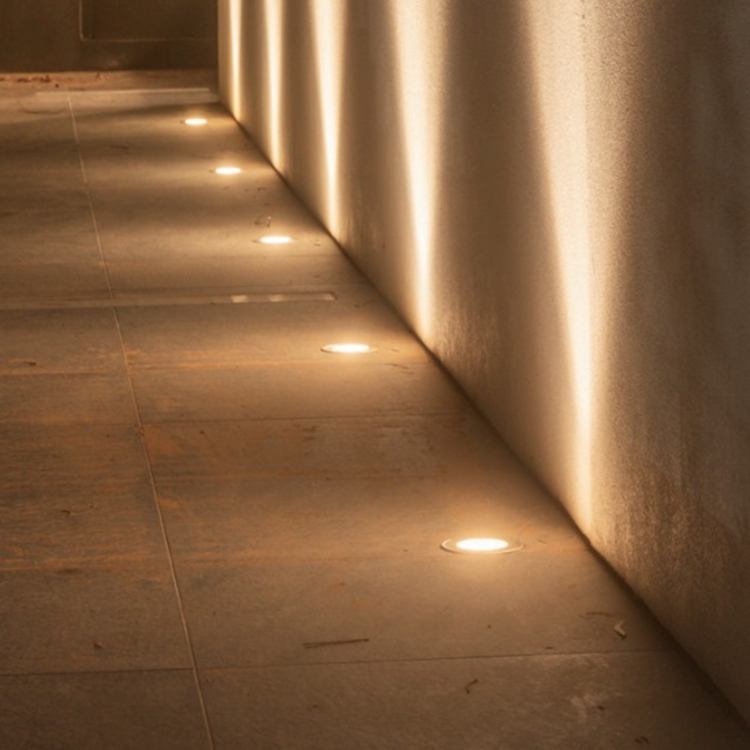
Path lights work best spaced evenly and aimed downward to avoid glare at eye level — a common mistake is placing them too close together and creating a runway effect. For garden beds and feature planting, low-level uplights positioned at the base of a specimen plant produce far more drama than overhead lighting. Steps and level changes deserve their own dedicated treatment; recessed or surface-mounted step lights are a cleaner solution than trying to angle a path stake light at a tread.
Directional outdoor spotlights give you the most flexibility for accent work — adjustable heads mean you can repoint the beam as plants grow or the garden layout changes.
Colour Temperature in the Garden
Warm white (2700–3000K) is the standard choice for garden lighting. It flatters foliage, timber decking, and stone pavers, and it reads as inviting rather than clinical. Cooler whites (4000K and above) work in specific situations — security floodlights, for instance — but for a garden you’re decorating rather than securing, stay in the warm end of the spectrum. Selected models in our 12V garden lighting range include integrated LEDs with a fixed colour temperature, so check the specs before ordering if consistency across your garden is important to you.
Garden Lights FAQs
Can I install garden lights myself in Australia?
It depends on the voltage. Low-voltage 12V systems — which run off a plug-in transformer — are generally DIY-friendly, and no licence is required to lay the cable and connect fittings. Any work involving a 240V circuit, including burying mains cable or wiring a new outdoor circuit to the switchboard, must be carried out by a licensed electrician under Australian law.
What IP rating do I need for garden lights?
For most outdoor garden use, aim for at least IP44, which protects against splashing water from any direction. Fittings placed at ground level, in garden beds, or subject to lawn watering should ideally be IP65 or above. Check each product’s individual specification — ratings vary even within the same style family.
How far apart should path lights be spaced?
A common starting point is 2–3 metres apart for a path lit to a comfortable walking level, though this depends on the beam angle and output of the specific fitting. Wider spacing with a stronger fitting often looks more natural than tight rows of low-output stakes. Aim for overlapping pools of light rather than bright spots with dark gaps between them.
Are garden lights suitable for the Australian climate?
Quality outdoor fittings are designed for it — but material choice matters. Look for powder-coated aluminium or stainless steel hardware rather than bare plastics, which degrade quickly under Australian UV levels. Coastal areas add the extra challenge of salt air, so marine-grade finishes or specifically rated coastal fittings are worth the investment if you’re within a few kilometres of the ocean.
Do garden lights need a separate circuit?
Not always. Low-voltage 12V systems plug into an existing GPO, so no new circuit is needed. For 240V installations, your electrician will advise whether your existing outdoor circuit has capacity or whether a dedicated circuit is the safer option — particularly if you’re also running outdoor power points or an alfresco appliance on the same line.