

Tiffany Lamps: A Buyer's Guide to Styles, Glass and Spotting Quality
16th Nov 2026
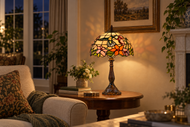
A Tiffany lamp is a shade made from individual pieces of coloured art glass joined by copper foil and lead solder, lit from within so the glass glows. The lamps sold today are Tiffany-style reproductions inspired by the work of Louis Comfort Tiffany in the late 1800s and early 1900s, not antiques, and they range from mass-produced imports to careful handcrafted pieces worth having for decades. Knowing what separates one from the other saves you from disappointment.
What makes a lamp Tiffany-style
The defining feature is leaded stained glass. Each small piece of coloured or textured glass is wrapped individually in copper foil tape, then all the pieces are soldered together to form the shade. The solder lines become the dark outlines you see from outside the shade and the warm grid of light you see when it’s switched on. That construction is what distinguishes a genuine Tiffany-style fitting from a painted-glass or plastic imitation. If you hold a shade up to a light and the colour is printed on rather than in the glass itself, it’s not Tiffany-style in any meaningful sense.
The base matters too. Original Tiffany bases were cast bronze, and quality reproductions use heavy cast resin or metal. A base that feels light or hollow relative to its size is a sign that cost-cutting has happened throughout the product, not just in the base.
Classic patterns and what they suit
Dragonfly shades use repeating insect motifs with iridescent blue-green wings, usually on a cream or amber background. They suit a study, a reading nook or a living room side table where you want something with visual detail up close. Wisteria patterns cascade downward in purple, blue and green clusters and work well where the lamp sits at eye level from a seated position, because that hanging botanical movement reads best from below. Peacock designs tend to be bolder, with richer jewel tones, and they can anchor a larger shade diameter of 40cm or more without looking fussy.
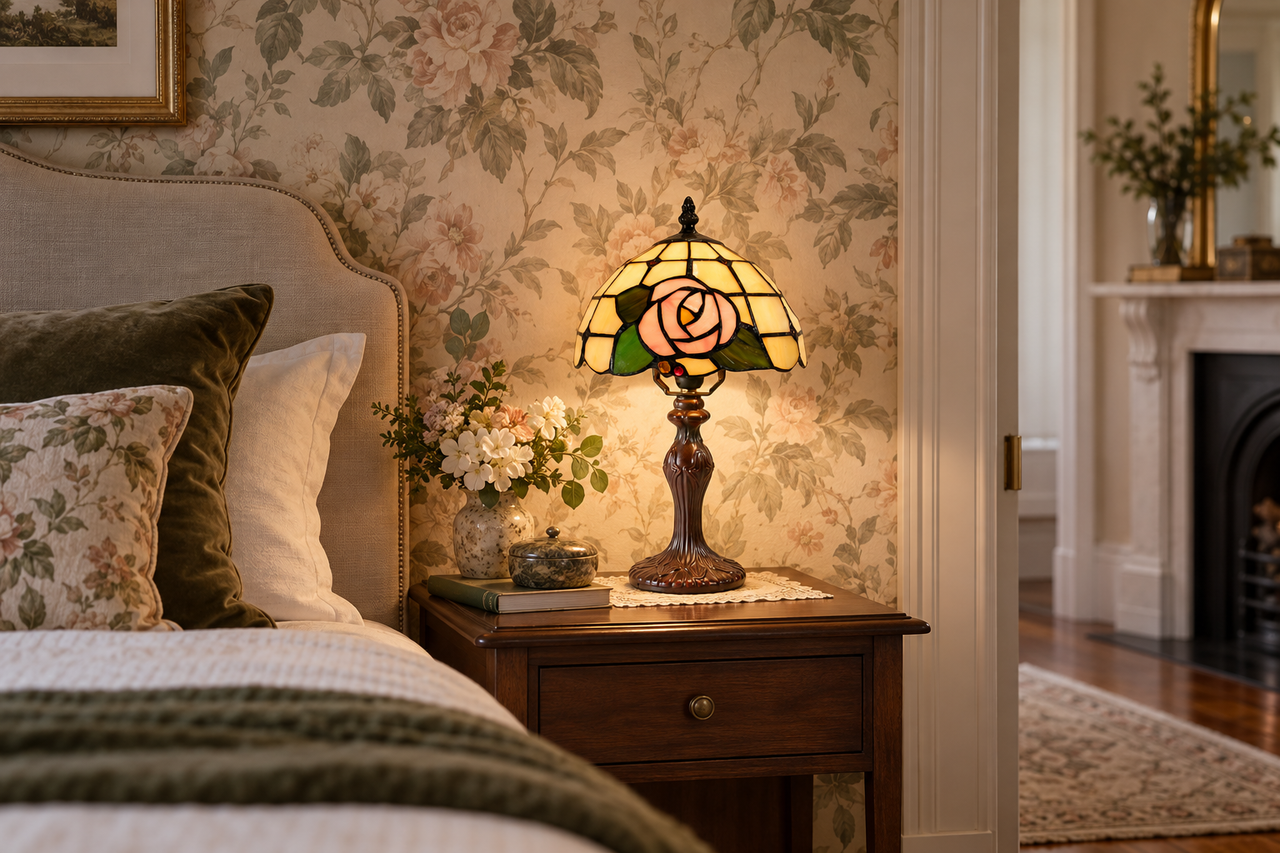
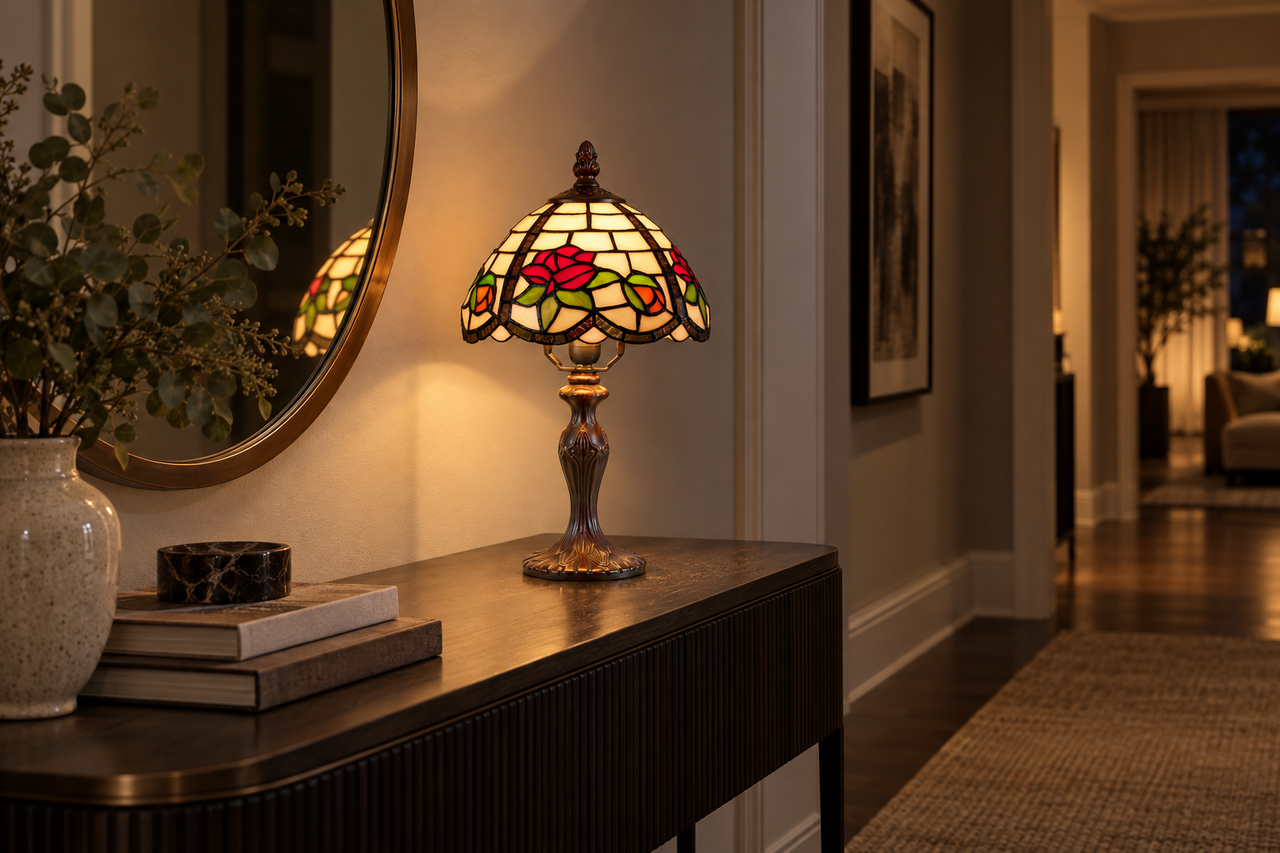
Rose and floral patterns are the most versatile. They read as warm and domestic rather than decorative-statement, which makes them a natural fit for a bedroom or a hallway console. Geometric patterns, the ones that look almost like a mosaic or a Frank Lloyd Wright window, suit interiors with a mid-century or Arts and Crafts sensibility.
How to judge quality before you buy
Glass
Good Tiffany-style glass has visible texture and depth. Hold the shade to light and look for variation within each piece, the slight swirling, streaking or bubbling that comes from art glass rather than flat window glass. Uniform, perfectly clear colour with no texture is a sign of cheaper material. Thickness across a shade should be reasonably consistent. Very thin pieces crack more easily and transmit light unevenly.
Solder lines
Run your finger along a solder line on a quality shade and it will feel rounded and smooth, raised slightly above the glass surface. Flat, pitted or lumpy solder suggests the foiling and soldering was rushed. The lines should follow the pattern cleanly. Gaps where you can see unsoldered foil, or blobs where solder has been dropped rather than flowed, are quality tells to watch for in product photography. Zoom into the product images and look at the joins.
Base weight and finish
Pick the lamp up (or if buying online, check the listed weight). A table lamp with a 30cm shade should weigh at least 2kg to sit stably. The finish on a quality base, whether antique bronze, aged brass or painted, should be even without obvious brush marks or pooling. Check where the cord exits the base: a tidy rubber grommet and a straight exit point are basic signs of proper assembly.

Sizing for bedside versus feature lamp
For a bedside lamp on a standard Australian bedside table (around 50-55cm tall), a shade diameter of 25-35cm works well. The bottom of the shade should sit roughly at seated eye level or just below, so about 55-65cm from the floor when the lamp is on the table. Going wider than 35cm at the bedside tends to overpower the space unless the room is large and the bedhead is a visual anchor.
As a feature lamp on a console, side table or in a reading corner, you have more latitude. Shades from 40-50cm diameter hold their own in a living area and reward the extra detail in the glass pattern. The Tiffany table lamp range covers both sizes, so filter by shade diameter once you know your table height. For bedside options specifically, the bedside table lamp category has them filtered alongside other styles if you’re comparing.
Bulb choice makes a real difference
The whole point of a leaded glass shade is what happens when light passes through it, so bulb choice is not an afterthought. A warm white globe at 2700K brings out amber, red and green tones in the glass beautifully. A cooler globe at 4000K or above will flatten the colour and make the shade look greyish when lit. We get asked this most weeks: yes, a standard E27 warm LED works well in most Tiffany-style fittings, but check the product page for the recommended wattage cap, because an enclosed shade traps heat differently from an open one.
A low-wattage globe, 4-8W LED equivalent, is usually plenty. The shade is doing the visual work. You’re not trying to light the whole room from a Tiffany lamp. If you want to dim the light, check whether the specific fitting accepts a dimmable globe, as not all do.
Cleaning and care
Dust is the main enemy. A dry microfibre cloth or a soft natural-bristle brush run lightly over the glass surface every few weeks keeps the shade looking its best. Avoid spraying any liquid directly onto the shade, water getting into solder joins over time can cause oxidisation of the foil underneath. If the shade needs a proper clean, wipe each glass piece with a barely damp cloth and dry it immediately. The base can be dusted normally. If it has a patinated or antique finish, avoid abrasive cloths that will scratch through the surface layer.
Tiffany-style lamps are not fragile if treated sensibly, but the joins are only as strong as the solder. Moving a lamp by gripping the shade rather than the base is the most common way damage happens.
If you’re browsing more broadly, the full table lamp range covers everything from minimalist ceramic bases to rattan and sculptural designs alongside the Tiffany-style options.
FAQs
Are Tiffany lamps expensive to run?
No. Most Tiffany-style table lamps take a standard E27 globe, and a 6W warm LED runs for less than a dollar a month at typical Australian electricity rates. The shade itself uses no power, only the globe does.
How can I tell if a Tiffany lamp is real stained glass?
Look at each glass piece against light. Real art glass has visible internal texture, colour variation and sometimes small bubbles. If the colour looks printed or perfectly flat, it’s likely painted glass or plastic. The solder lines should also be raised and smooth, not flat or stuck-on-looking.
Can I use a Tiffany lamp in a humid bathroom?
Standard Tiffany-style table lamps are not rated for wet areas. They suit dry living spaces, bedrooms and studies. If you want decorative stained glass lighting in or near a bathroom, look for a fitting with an appropriate IP rating for that location.
What’s the difference between Tiffany-style lamps and genuine Tiffany antiques?
Genuine Tiffany Studios pieces from the late 1800s to 1930s are museum-quality antiques that sell at auction for tens of thousands of dollars. Tiffany-style reproductions use the same leaded copper-foil glass technique but are made today and are priced for everyday use. They are sold as reproductions, not originals.