

The Interior Designer's Guide to Pendant & Chandelier Lighting
Posted by Zest Lighting on 5th May 2026
Lighting is often referred to as the jewellery of a room. It is the defining element that can elevate a standard space into a curated, magazine-worthy interior. However, specifying the right lighting, particularly statement pieces like pendants and chandeliers, requires more than just an eye for beautiful design. It demands a technical understanding of scale, proportion, suspension height, and luminosity.
At Zest Lighting, we know the pain points design-conscious homeowners and interior designers face: the prohibitive costs of authentic showroom pieces and the lacklustre quality of big-box hardware alternatives. That is why we champion attainable luxury, bringing you meticulously curated, premium craftsmanship without the traditional designer markup.
Whether you are an industry professional outfitting a boutique commercial space or a homeowner aiming to create a breathtaking entryway, this comprehensive specification guide will walk you through exactly how to select, size, and position pendant and chandelier lighting.
Why Specification Matters in Lighting Design
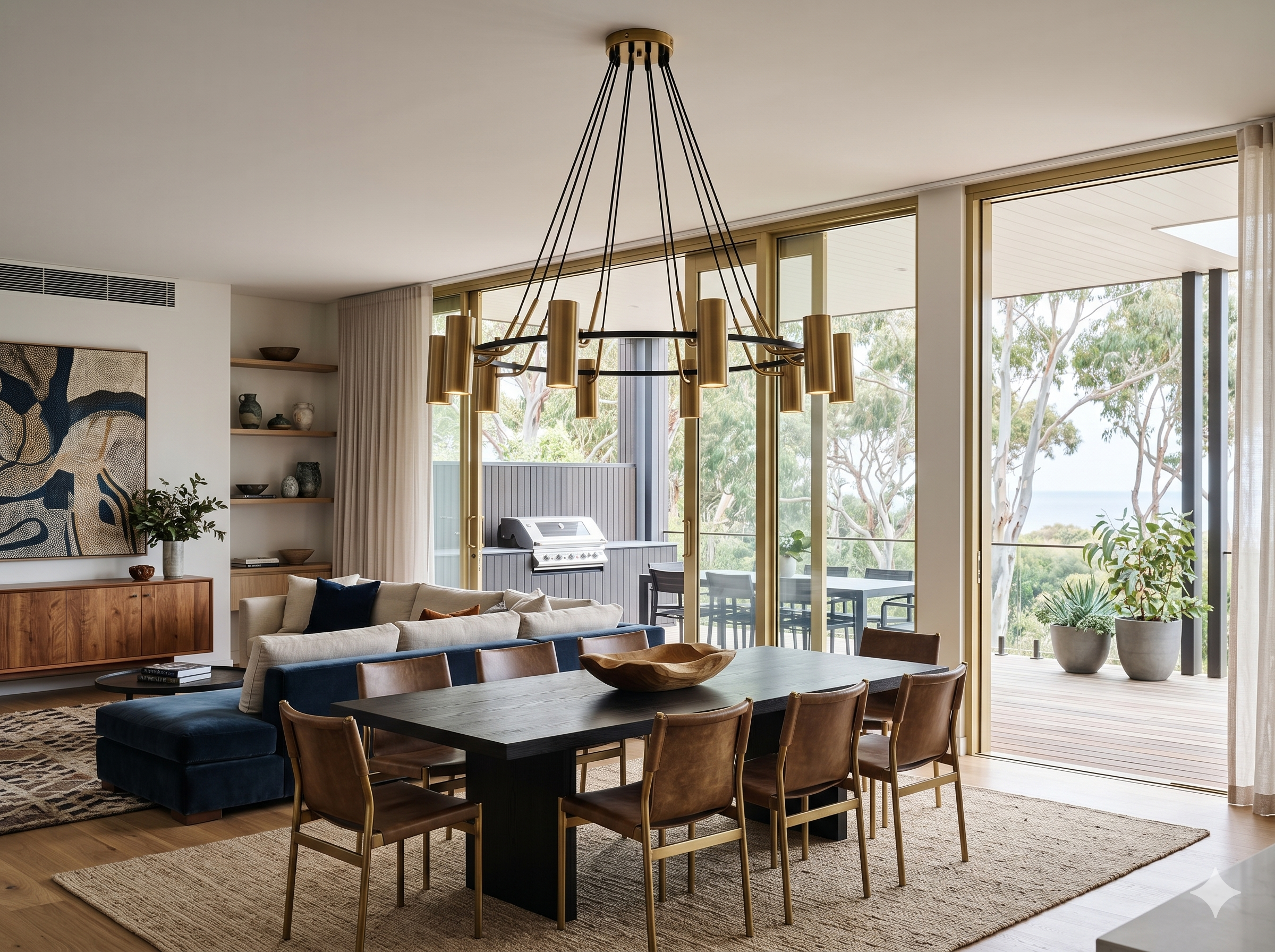
Shop: Spot 10 Light Black with Brass Chandelier
Choosing a luminaire based purely on aesthetics is a common pitfall. A chandelier that looks majestic in a showroom can easily swallow a small dining room, while delicate pendants might get lost above a massive kitchen island. Proper specification ensures:
- Visual Balance: The fixture harmonises with the room’s volume and architectural features.
- Functional Illumination: The light provides adequate task or ambient lighting without glaring into the eyes of inhabitants.
- Spatial Flow: Suspension heights do not obstruct sightlines or physical movement.
How to Specify Chandelier Lighting
Chandeliers are the ultimate statement makers. Traditionally reserved for formal dining rooms and grand foyers, modern design has brought chandeliers into bedrooms, bathrooms, and living areas. Here are the professional rules of thumb for getting the scale perfectly right.
1. Determining the Right Diameter
A quick interior design formula to determine the ideal chandelier diameter involves using the room’s dimensions.
The Metric Formula
- Measure the length and width of your room in metres.
- Add these two numbers together.
- Multiply the total by 8.5.
- The result is your ideal chandelier diameter in centimetres.
Example
If your living room is 4 metres wide and 5 metres long:
4 + 5 = 9
9 x 8.5 = 76.5 cm
*You should look for a chandelier with a diameter of approximately 75 to 80 cm.
2. Sizing for a Dining Table
When hanging a chandelier over a dining table, the room dimensions matter, but the table size takes precedence.
- The chandelier's diameter should be roughly one-half to two-thirds the width of the dining table.
- Ensure the fixture leaves at least 30.5 cm of clearance on all sides of the table to prevent tall guests from bumping their heads as they sit or stand.
3. Suspension Height: How Low Should You Go?
- Over a dining table:
The bottom of the chandelier should sit 75 to 90 cm above the tabletop (based on a standard 240 cm ceiling height). Add approximately 7–8 cm of suspension length for every additional 30 cm of ceiling height. - In a foyer or living room (open space):
The bottom of the fixture should be at least 210 cm from the floor to allow for safe and comfortable clearance beneath it. - In a two-storey foyer:
The chandelier should hang around the height of the second floor or slightly below, ensuring it is visible from outside windows while not obstructing the upper-level walkway.
How to Specify Pendant Lighting
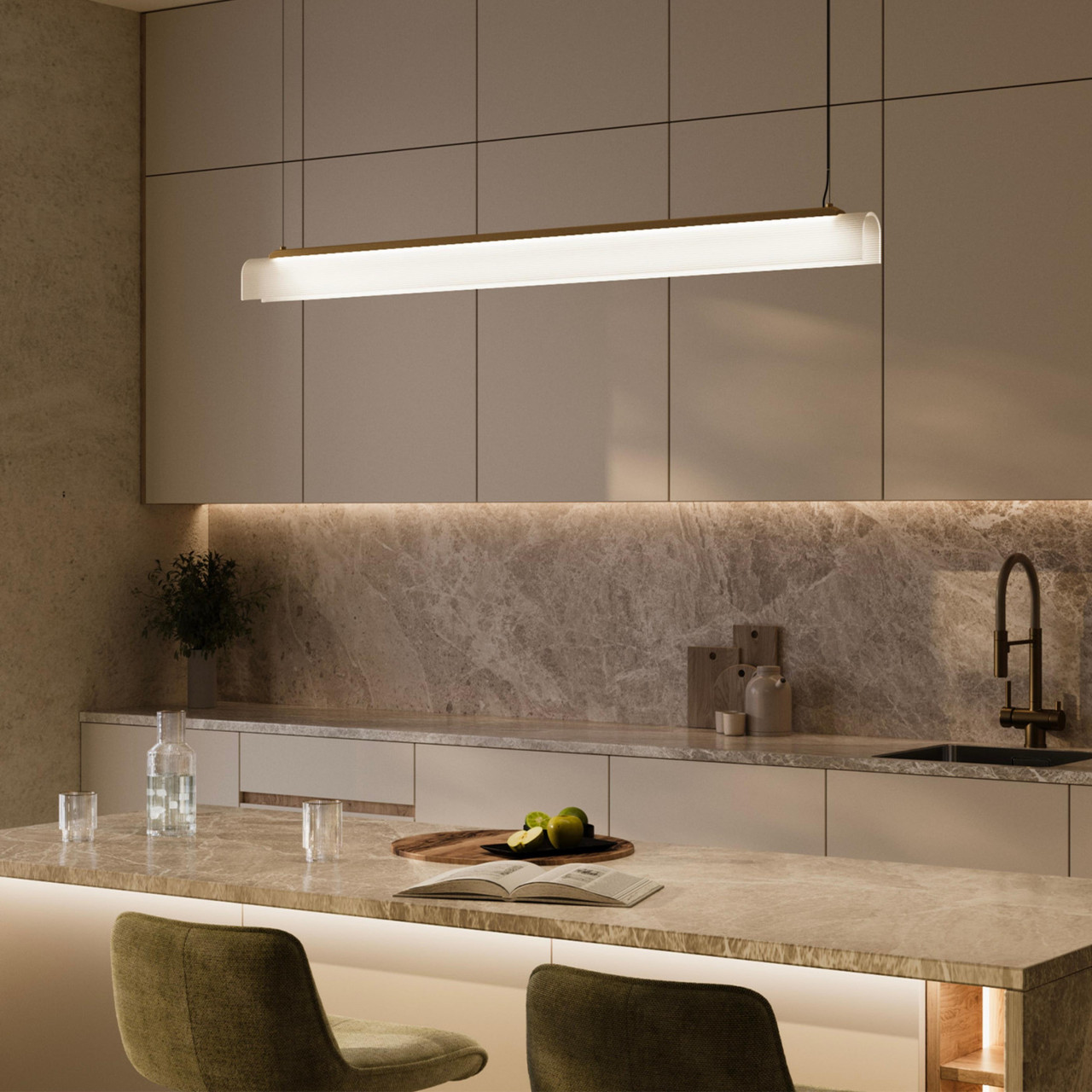
Shop: Edge Frosted Ribbed Glass Old Brass Linear Pendant
Pendant lights are incredibly versatile, offering both task lighting and aesthetic rhythm. They are most commonly used over kitchen islands, bathroom vanities, and bedside tables.
1. Spacing Pendants Over a Kitchen Island
The “Rule of Three” is a classic design principle, but the exact number of pendants depends on the size of your island and the diameter of each fixture.
Spacing Formula:
Leave at least 60 to 75 cm of space between each pendant (measured from the centre of one fixture to the centre of the next).
Edge Clearance:
Allow approximately 15 cm from the edge of the island to the outer edge of the outermost pendants.
Pro Tip:
For larger islands (over 240 cm), two oversized statement pendants often create a more refined, modern look than a crowded row of smaller fixtures.
2. Pendant Suspension Heights
Kitchen Islands:
Hang pendants 75 to 90 cm above the countertop. This ensures optimal task lighting while keeping the fixtures above eye level for both standing and seated conversations.
Bedside Pendants:
If replacing table lamps, suspend pendants approximately 45 to 60 cm above the mattress top, low enough for reading, but high enough to avoid interfering with bedside items.
The Technical Nuances: Lumens, Kelvins, and Dimming
A beautifully scaled light fixture will only look good if the light it emits is appropriate for the space. When specifying, you must look at the technical data sheet.
Colour Temperature (Kelvins)
The mood of a room is dictated by colour temperature.
- 2700K (Warm White): Cozy, intimate, and inviting. Best for living rooms, bedrooms, and dining chandeliers.
- 3000K (Soft White): Crisp yet warm. Ideal for kitchen pendants, bathrooms, and transitional spaces.
- Avoid 4000K+ in residential spaces unless specifically required for high-contrast task spaces, as it can feel sterile and commercial.
Brightness (Lumens)
Forget wattage; specify by lumens. A standard dining room chandelier should output between 1,000 to 2,000 lumens total. Always ensure your statement lighting is hooked up to a compatible LED dimmer switch to allow the atmosphere to transition from bright task lighting to moody, ambient glowing.
Balancing High-End Aesthetics with Project Budgets
One of the greatest challenges for interior designers and design-savvy homeowners is achieving a high-end, bespoke look without completely blowing the project budget on a single fixture.
At Zest Lighting, we bridge this gap. You don't have to settle for the uninspired, mass-produced designs found at big-box hardware stores just to stay on budget. By curating designer-inspired pieces, we provide the prestigious aesthetics, think hand-blown glass, brushed brass finishes, and architectural silhouettes, allowing you to allocate your budget smartly while maintaining the high-quality look of a luxury showroom.
Frequently Asked Questions
Can you mix pendants and chandeliers in an open-plan space?
Yes. To successfully mix fixtures, ensure they share a cohesive element—such as a similar finish (e.g., aged brass), a shared material (e.g., ribbed glass), or a complementary geometric shape. Avoid matching them perfectly; instead, let one fixture be the "star" (the chandelier) and the other play a supporting role (the pendants).
How do I choose between a linear chandelier and a round chandelier?
Look at the shape of the furniture beneath it. Round or square tables look best with round, globe, or drum chandeliers. Long, rectangular dining tables or highly elongated kitchen islands benefit from linear suspension lights that distribute illumination evenly across the surface.
Are heavy chandeliers difficult to install?
Any chandelier weighing over 20-25kg requires special ceiling reinforcement. Always consult with a licensed electrician to ensure your junction box is rated for the fixture's weight, and specify heavy-duty brackets if necessary.