

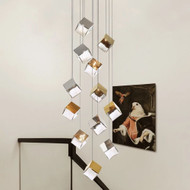
Stairway, Void & High Ceiling Lighting: An Australian Guide
23rd Sep 2026
The best stairwell lighting ideas combine a pendant or chandelier dropped to fill the void with adequate lumen output for safe stair navigation, scaled so the fixture reads well from every sightline — the entry below, the landing above, and the staircase itself. Get the drop length and diameter right first, then choose a style that suits the architecture.
Understanding the Void: Heights, Drops & Scale
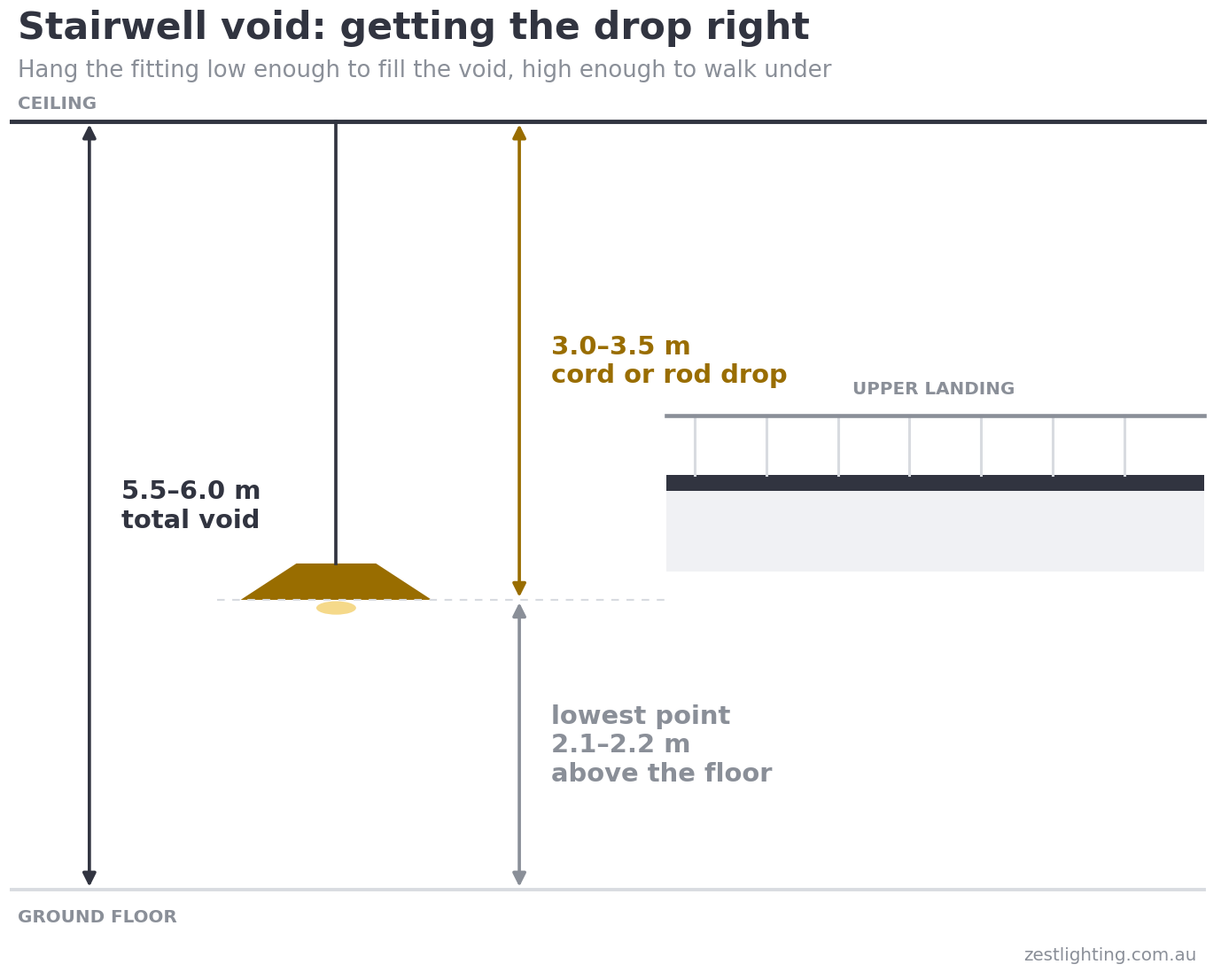
A standard Australian two-storey home has a ground-floor ceiling of roughly 2.4–2.7 m and a floor-to-floor height of around 3.0–3.3 m, which puts the underside of the upper floor at approximately 5.5–6.0 m above the ground-floor slab in an open void. That’s a very different proposition from a single-room ceiling, and it’s the number that drives everything else.
Calculating drop length
Hang a pendant or chandelier so its lowest point sits roughly 2.1–2.2 m above the ground-floor level — high enough that no one on the ground floor will walk into it, low enough that the fixture doesn’t disappear into the ceiling and look insignificant from below. In a 5.5 m void, that means a cord or rod drop of around 3.0–3.3 m. Always verify the maximum drop available for a specific fixture before ordering; some pendants ship with a fixed cord that can be extended, others cannot. Measure the void height precisely (a laser measure is worth the hire cost) before shortlisting fittings.
Choosing the right diameter
A fixture that looks enormous on a showroom floor can appear underwhelming floating in a double-height void. As a working rule, add the void’s width and length in metres, then convert that sum to centimetres — so a void 2.5 m wide by 3.0 m deep suggests a fitting around 55 cm in diameter. Single dramatic pendants work well in tighter stair shafts; multi-light arrangements or wide chandeliers suit larger open voids where you need visual mass.

Single Statement vs Multi-Pendant Clusters
Both approaches work beautifully in voids; the choice comes down to architecture and personal taste.
Single statement pendant or chandelier
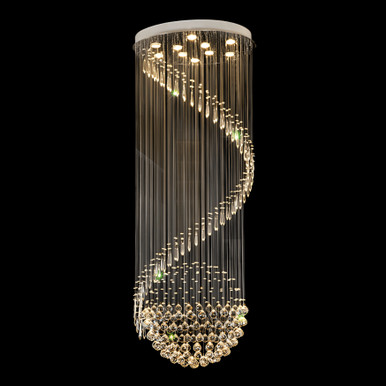
One large fitting centred over the void creates a clear focal point visible from the entry, the landing, and the staircase mid-flight. It’s simpler to wire (one ceiling rose, one circuit), and it tends to look more composed in narrower stair shafts or where the ceiling canopy is small. A sculptural orb, a tiered crystal chandelier, or a bold drum shade all read well at this scale. Browse the stairway pendant lights range for fittings designed with extended drop options.
Multi-pendant clusters & linear arrangements
Hanging three to five pendants at staggered heights over a wide open void fills the space without requiring a single enormous shade. This approach also lets you use mid-sized fittings that are easier to source with the exact drop length you need. A linear grouping that follows the rake of the staircase — each pendant a step higher than the last — is a contemporary look that works especially well in modern and Hamptons-style homes. Explore the full high ceiling pendant lights collection for fittings with canopy plates that accommodate multiple drops from a single ceiling point.
Sightlines: How the Fitting Looks from Every Angle
A stairwell is unique because you see the light fitting from multiple positions and elevations — standing at the front door, halfway up the stairs, and from the upper landing looking down. Each vantage point matters.
- From below: You’re looking up at the underside of the shade and the full length of the cord or rod. A fitting with an attractive base or open structure (cage, crystal, open frame) looks intentional rather than like a bare ceiling socket.
- From mid-stair: This is where glare is a real risk. A shade or diffuser that conceals the bare globe prevents an uncomfortable blast of light at eye level when you’re on the stairs. Opaque or semi-opaque shades, smoked glass, or downward-facing diffusers all address this.
- From the upper landing looking down: The top of the fitting — the canopy, the cord, any decorative chain — is visible here. Choose fittings where the full silhouette, not just the shade, is considered.
The Practical Reality: Bulb Access & Cleaning
This is the question most buyers don’t think about until they’re standing in a void with a ladder trying to figure out how to re-lamp a fitting 5 m in the air. It’s worth planning for before you order.
LED sources are your best friend here. A quality integrated LED fitting or an LED globe with a rated life of 25,000–50,000 hours will likely outlast your desire to redecorate. At 6 hours of daily use, that’s 11–22 years without a re-lamp. Check product pages carefully — selected models include integrated LED arrays, which means no globe replacement at all.
For fittings with replaceable globes, consider how you’ll access the fitting. A scaffold board rented for the original install is worth keeping in mind for the future. Some homeowners have the void wired with a winch-style lowering mechanism (a licensed electrician can advise on this during installation). At minimum, choose a fitting where globes are accessible without disassembling the shade.
Dust accumulation on crystal, glass, or open metalwork at height is real. Smooth, closed surfaces collect less dust and are easier to wipe down from a ladder; intricate crystal drops or open cage designs will need occasional attention. Factor this into your style choice, especially in Australian conditions where dust can be persistent.
Electrician Requirements & Installation Notes
Hardwiring any new ceiling light in Australia is licensed electrical work — it cannot legally be DIY. For a void or stairwell installation, this is even more important because the install almost certainly requires working at height, and the ceiling point may need to be reinforced to carry the weight of a heavier chandelier. When briefing your electrician, confirm:
- The structural capacity of the ceiling at the intended hang point (relevant for fittings over 5 kg).
- Whether you want the light on a dimmer circuit — tell the electrician before installation so the correct wiring and compatible dimmer switch are installed. Check that any chosen fitting is compatible with leading-edge or trailing-edge dimmers (product pages will note this where applicable).
- The exact drop length required, so the electrician knows how much excess cord or cable chain to leave.
For grand entrance voids in heritage or contemporary homes, a statement chandelier from the entryway chandeliers collection is designed with these installation requirements in mind, with canopies and suspension hardware rated for the task.
FAQs
How long should a pendant be for a stairwell void?
For a typical Australian two-storey void of around 5.5–6.0 m, you’ll generally need a total drop of 3.0–3.5 m from the ceiling rose to the bottom of the fitting. The goal is to position the lowest point at approximately 2.1–2.2 m above ground-floor level. Measure your specific void height precisely before ordering, and confirm the maximum adjustable drop on the product page.
Can I use a chandelier in a staircase void?
Yes — a staircase void is actually one of the best locations for a chandelier, because the double-height space gives you the vertical room to hang a fitting that would overwhelm a standard 2.4 m ceiling. Ensure the fitting diameter is proportional to the void dimensions, the installation point can support the weight, and the work is carried out by a licensed electrician.
What’s the best way to avoid glare on the stairs from a pendant light?
Choose a fitting with a shade, diffuser, or opaque globe that directs light downward and shields the bare source from horizontal sightlines. Smoked glass, fabric shades, and frosted diffusers all reduce glare effectively. Avoid clear-glass or open fittings positioned at eye level for someone on the staircase, unless the globe itself is a low-glare decorative filament type.
How do I change bulbs in a stairwell pendant that’s very high up?
The most practical solution is to choose an integrated LED fitting with a long-rated lifespan so re-lamping is rarely necessary. For fittings with replaceable globes, discuss a winch-lowering system with your electrician at installation time, or plan for scaffold or a tall multi-function ladder for occasional access. This is worth solving before installation rather than after.