

Outdoor Security Lighting: Sensor Lights That Actually Deter
12th Oct 2026
The best outdoor sensor lights combine a reliable detection method (PIR or microwave), enough lumen output to illuminate the full zone they cover, and settings you can actually adjust to suit your property. A cheap light that trips on possums every 20 minutes, or misses someone walking up the side path, isn’t security lighting. It’s just an annoyance.
PIR vs Microwave Sensors: What the Difference Means in Practice
Passive infrared (PIR) sensors detect the heat signature of a moving body crossing their field of view. They’re the standard on most residential fittings and they work well when positioned correctly. The catch is that PIR sensors need line-of-sight. If a person walks parallel to the sensor rather than crossing its beam, or if the fitting is mounted too high, detection range drops significantly.
Microwave sensors emit a low-level radar pulse and detect movement in three dimensions, including through some light obstructions. They’re harder to fool, more sensitive at range, and less affected by ambient temperature (PIR sensors can struggle in Australian summer when the air temperature approaches body temperature). The tradeoff is cost, and microwave fittings can sometimes trigger on objects moving inside a nearby window. For most side paths and driveways, a well-placed PIR is sufficient. For a large dark corner or carport where you can’t control the approach angle, a microwave sensor is worth the premium.
Placement: Where Sensor Lights Actually Need to Go
Side paths are the most consistently under-lit part of Australian homes. A single wall light at the front of the house leaves a long dark corridor that anyone can walk along undetected. Mount a sensor light at each end of the path so that motion is detected on approach, not after arrival. Aim for a mounting height of 2.4 to 3 metres. Lower than that and someone can physically block the sensor. Higher than 3.5 metres and PIR coverage can thin out at ground level directly below the fitting.
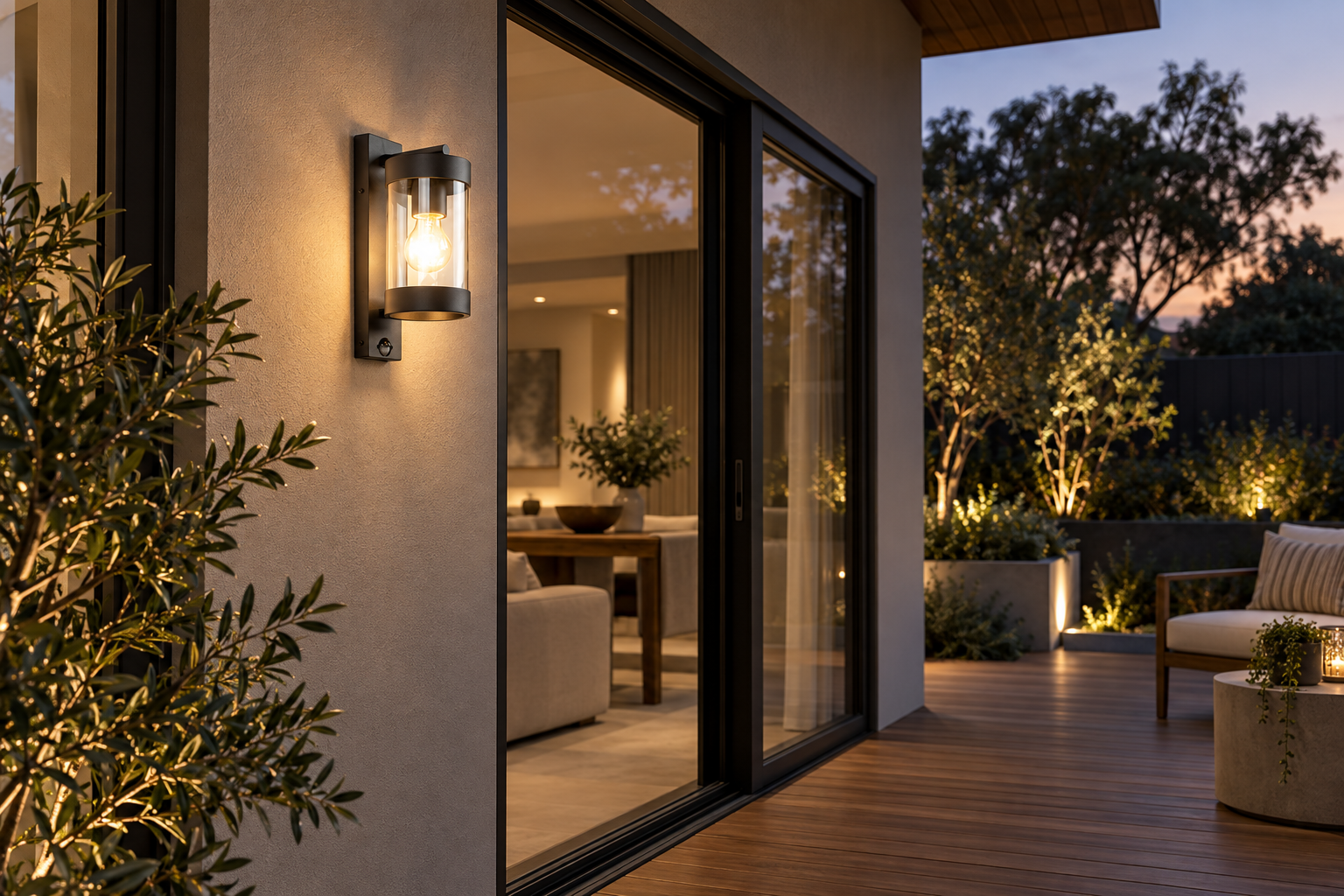
Driveways need coverage from the street entry point and near the garage or parking area. Two lights on opposite walls of the driveway entry, angled to overlap their beams, remove the shadow gaps that a single fitting leaves. For garages, a twin-spot or flood mounted on the eave above the door works better than a wall fitting beside it, because the beam can cover a wider horizontal arc.
Dark corners behind sheds, at gate entries, or along the back fence line are high-priority areas that homeowners often leave last. A solar sensor fitting can work here precisely because running cable to a back corner is expensive and disruptive. More on the tradeoffs below.
One point that’s often skipped: check your sensor’s detection angle before you buy. Many PIR wall lights cover 120 to 180 degrees horizontally but have a narrower vertical angle. If you’re mounting on a side wall to cover a path running perpendicular to the fitting, make sure the spec confirms that horizontal range, not just the cone width used in marketing copy.
Lux, Lumens, and Duration Settings
Lumens measure total light output. Lux measures how much of that light lands on a surface at a given distance. For security purposes, you need enough lux at the edge of the zone you’re covering to clearly illuminate a person. A 1,000-lumen fitting sounds adequate but spread over a wide beam at 5 metres, it may only produce 20 to 30 lux at the far edge. For practical identification (face, clothing), you want at least 50 to 100 lux at the working distance.
Flood-style sensor lights in the 1,500 to 3,000 lumen range will handle most driveways and carport areas. For a side path where the fitting is closer to the subject, 800 to 1,200 lumens is usually plenty. Check the product page for beam angle and stated detection distance. Those two numbers together tell you more than lumens alone.
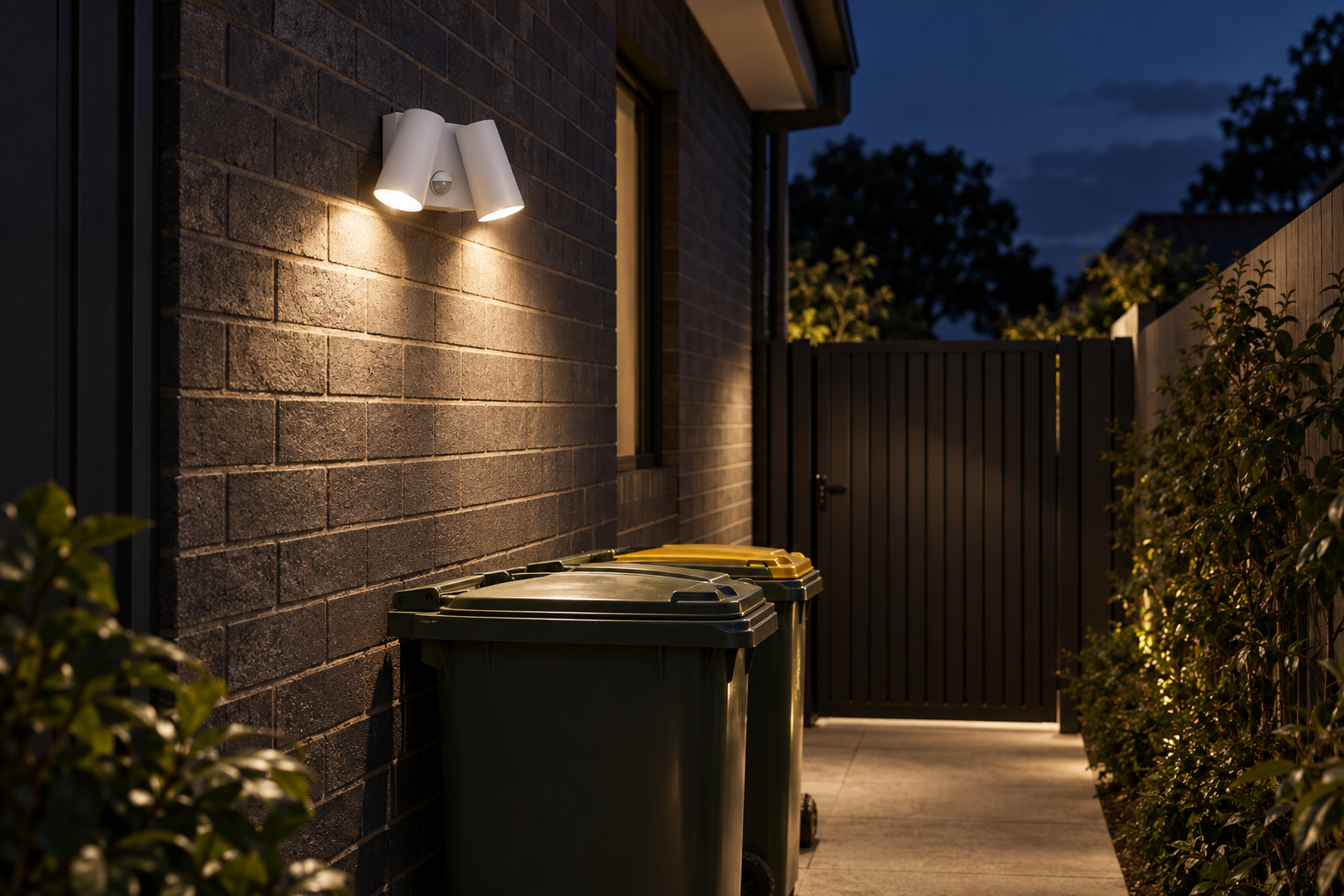
Duration settings typically range from 10 seconds to 10 minutes. For a path or driveway, 30 to 90 seconds is the practical range: long enough for someone to enter and exit the lit zone, short enough that neighbours aren’t bothered by a light staying on for a wandering cat. Sensitivity adjustment matters too. If your property backs onto bushland, dial sensitivity down on the side facing the scrub and keep it higher on the street-facing aspects. Browse the outdoor sensor lights range and filter by the features that matter to your situation, since adjustable sensitivity and duration are not universal across all models.
Pairing Fixed Lights with Sensor Lights
Sensor lights work best as a layer on top of baseline illumination, not as the only source of light. A property that’s completely dark until a sensor fires is actually less secure than one with a low-level ambient light from a fixed fitting, because a sensor light that pops on suddenly can be waited out. Someone who knows your sensor duration can simply stand still.
The practical approach is a fixed low-wattage light at the front entry or gate that stays on from dusk to dawn, combined with sensor lights at the approach zones. The fixed light removes deep shadow, the sensor light reacts to movement and draws attention. For driveways and larger areas, flood lights on a timer or photocell pair well with a sensor fitting mounted at a lower point on the same wall.
Solar Sensor Lights: Honest Assessment
Solar sensor lights have improved significantly, and they’re genuinely useful for locations where running cable is impractical. The real-world limitations are worth knowing before you buy.
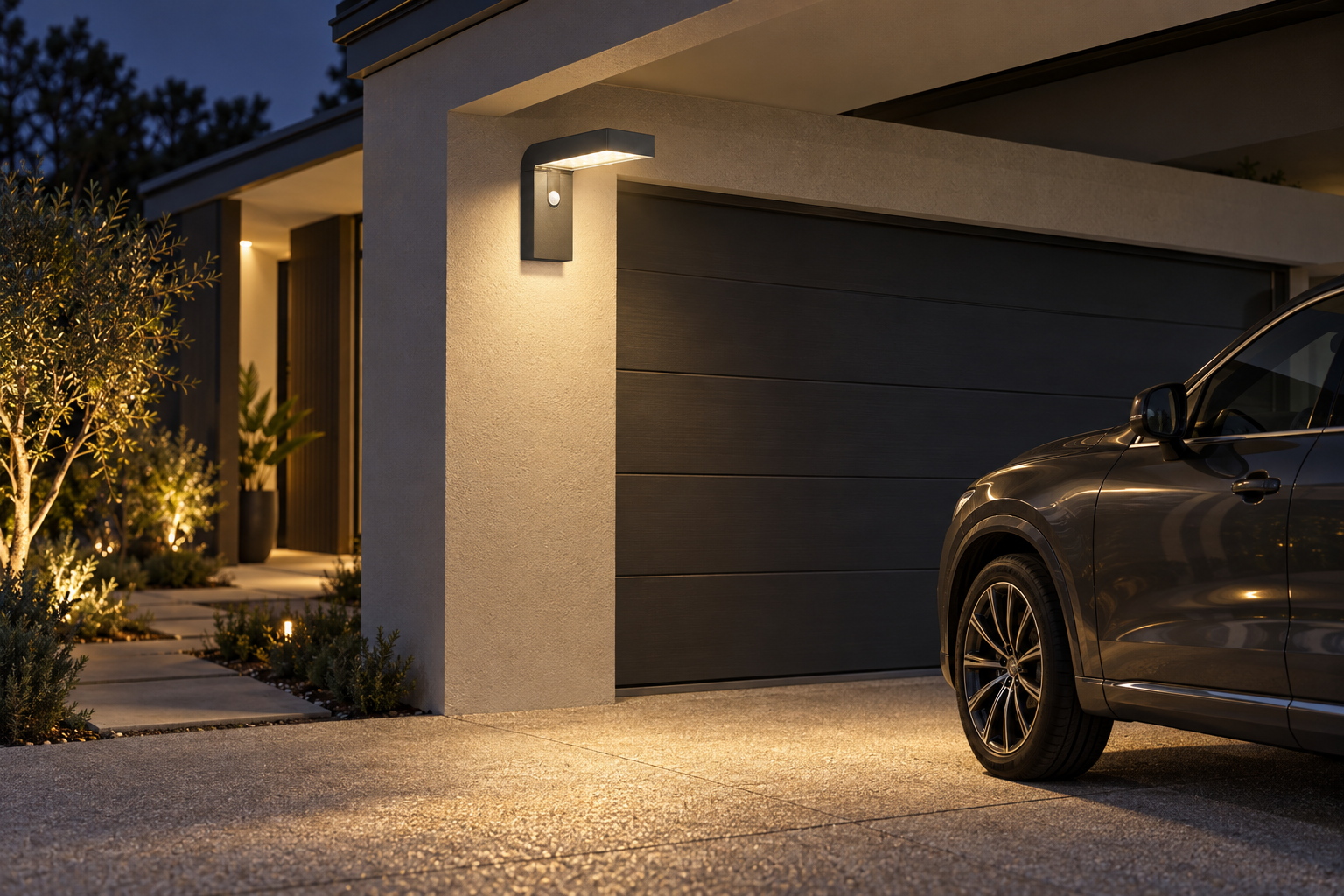
Battery capacity is finite. A solar sensor light that fires 20 times overnight in winter, when charge time is shorter, may be noticeably dimmer by 3am or may reduce its on-duration automatically to preserve reserve power. If the location genuinely needs full brightness all night every night, a hardwired fitting is the more reliable choice. Where solar works well is at back gates, garden sheds, down the side of the property, and any spot that sees occasional rather than constant traffic. The solar sensor lights in our range include models with separate solar panels that can be positioned for maximum sun exposure independently of the light head, which solves the problem of south-facing walls that would otherwise get inadequate charge.
Panel orientation matters in Australia. Face the panel north, angled between 15 and 30 degrees from horizontal depending on your latitude, and you’ll get the best daily charge cycle. A panel mounted flat against a south-facing wall in Melbourne or further south will underperform through winter months regardless of the fitting’s specification.
IP rating is another variable to check on the product page. Anything mounted outdoors should be at minimum IP44. Coastal locations subject to salt-laden air benefit from IP65 or above, and a fitting described only as ‘weather resistant’ without an IP rating should be treated with caution.
FAQs
What is the best position for an outdoor motion sensor light?
Mount PIR sensor lights at 2.4 to 3 metres high, positioned so people cross the sensor beam rather than walking directly toward it. For paths and driveways, corner-mounting where two surfaces meet gives the widest coverage angle without requiring multiple fittings.
How many lumens do I need for outdoor security lighting?
For side paths and entries, 800 to 1,200 lumens is usually enough. For driveways, carports, and large open areas, look for 1,500 to 3,000 lumens and check the beam angle, since a narrow spot at 2,000 lumens can leave the edges of a driveway in shadow.
Do solar sensor lights work through an Australian winter?
In Queensland and most of New South Wales, yes, reliably. In Victoria, South Australia, and further south, performance can drop in winter if the panel is poorly oriented or partially shaded. A north-facing panel angled around 20 to 30 degrees and a model with a generous battery capacity will give the best results through shorter days.
Is hardwiring an outdoor sensor light licensed electrical work in Australia?
Yes. Any fitting that connects to the 240V mains supply must be installed by a licensed electrician. Solar sensor lights and battery-operated fittings that don’t connect to mains power can be installed without an electrician, which is part of their practical appeal for retrofitting.