

Lighting for Low Ceilings: How to Light a 2.4m Room Well
2nd Oct 2026
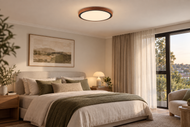
The best lights for low ceilings sit flush or very close to the ceiling plane, push light downward and outward rather than wasting it upward, and are scaled to the room so they don’t visually crowd the space. Australia’s standard 2.4 m ceiling is entirely workable — it just asks for a little more intention than a high-ceilinged room where almost anything goes.
Flush vs Semi-Flush: Choosing the Right Mount
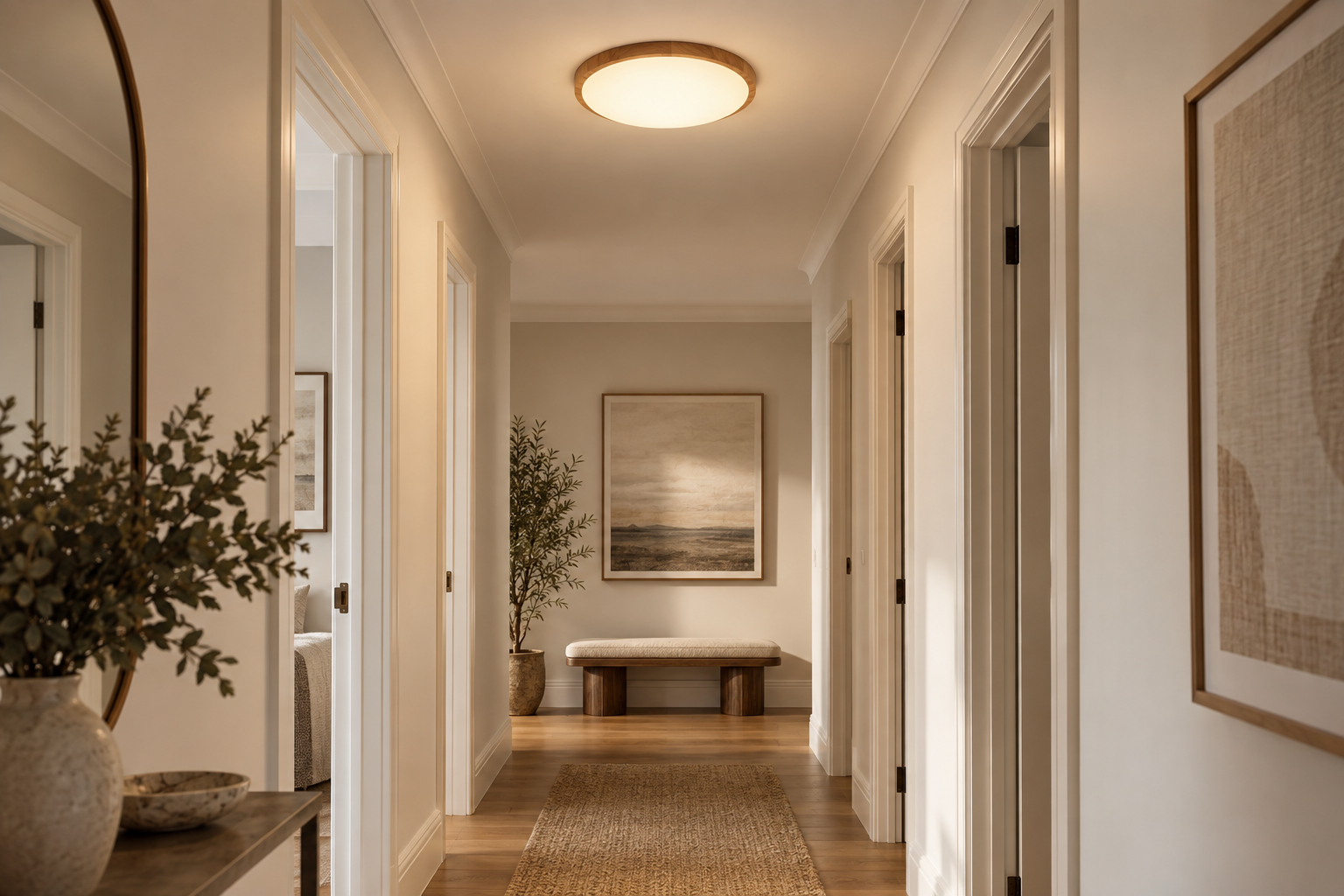
The first decision is how much drop you can afford. A true flush fitting — what most people call an oyster light — sits flat against the ceiling with no gap at all. These are the safest choice when headroom is genuinely tight, in hallways where people walk close to the centre of the ceiling, or in rooms with ceiling fans already eating into the available height.
A semi-flush or close-to-ceiling light drops somewhere between 10 cm and 30 cm. That small gap actually works in your favour: it allows some upward light to wash the ceiling, which tricks the eye into reading the room as taller. The practical rule is straightforward — if your fitting’s lowest point will clear 2.1 m from the floor, it’s safe for general traffic. In a 2.4 m room that means you can accommodate a drop of up to about 30 cm before you start eating into comfortable headroom.
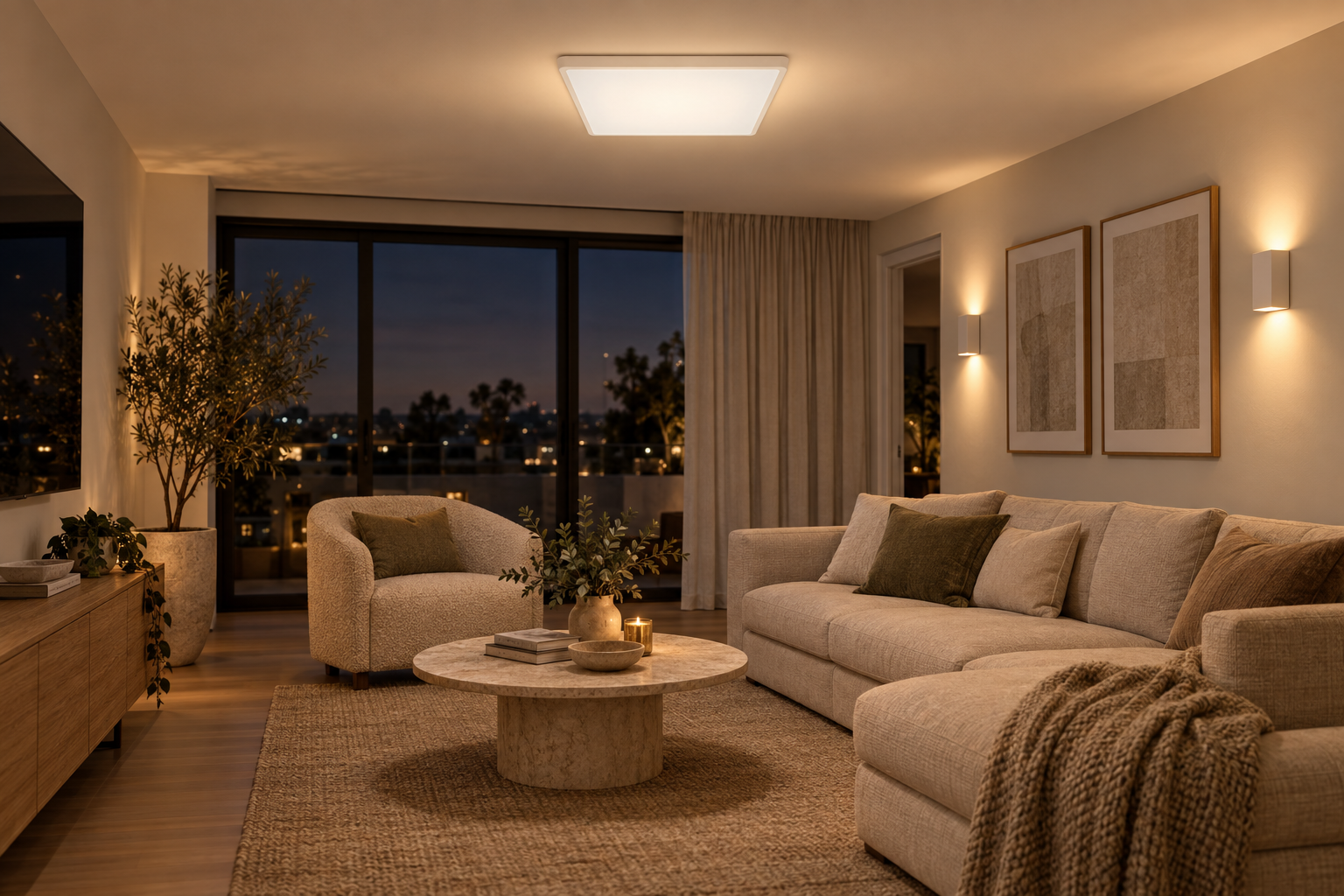
When comparing options, pay attention to the diffuser shape. A wide, shallow disc distributes light broadly across the room — ideal for a living area or bedroom where you want even ambient coverage. A deeper bowl or dome concentrates more light downward, which suits a kitchen or study where task brightness matters more than even wash.
When a Pendant Can Still Work
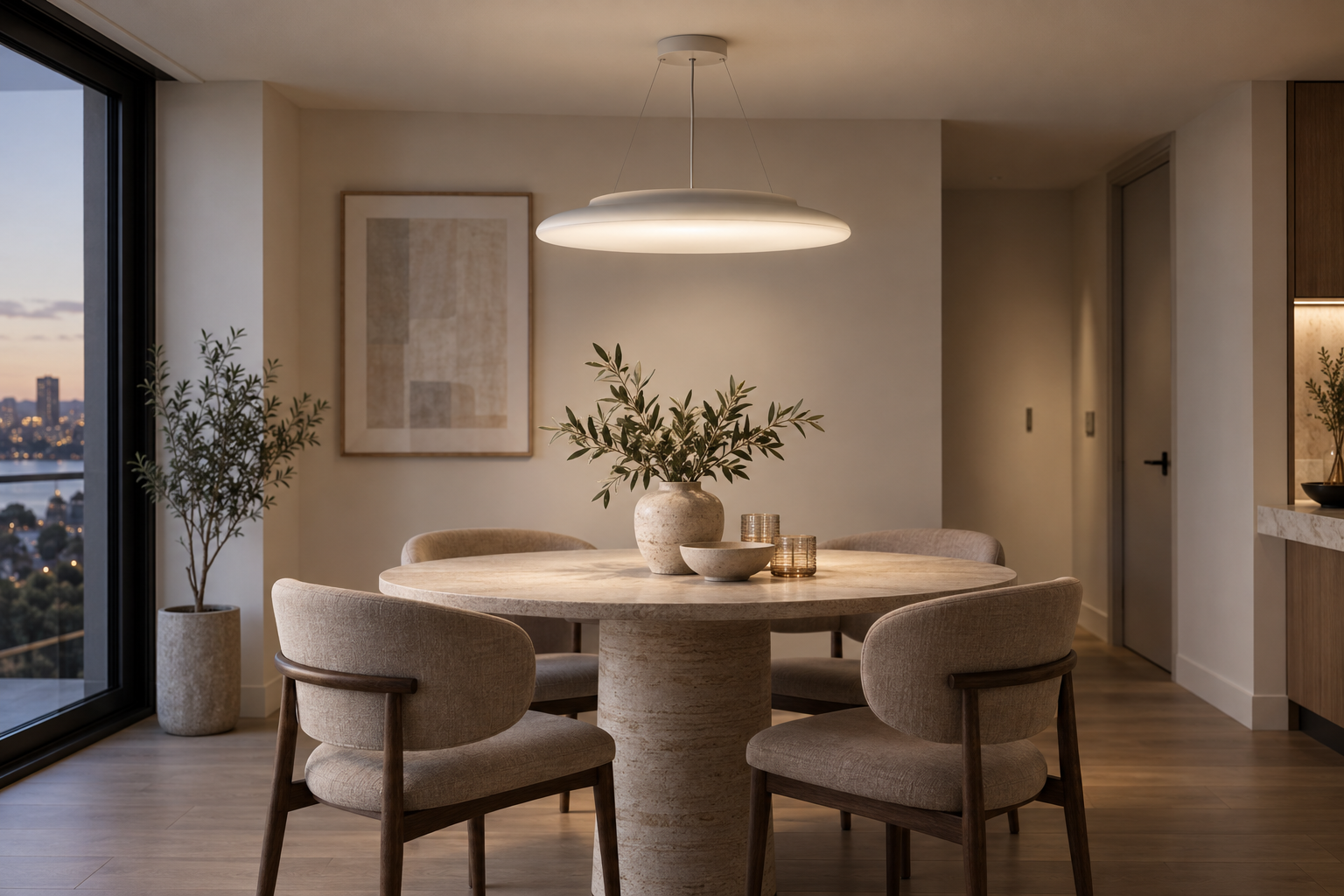
Pendants aren’t completely off the table in a 2.4 m room — they just need to be chosen and positioned carefully. The key is to look at low ceiling pendant lights specifically designed for this constraint: fittings with a short fixed canopy, a rise-and-fall mechanism, or a wide shallow shade profile that reads as a pendant without demanding much vertical space.
Over a dining table, the standard hang point is 75 cm to 85 cm above the table surface. In a 2.4 m room with a standard 75 cm table height, that puts the top of the shade at roughly 1.55 m — well clear of anyone walking past the ends of the table and close enough to cast flattering, intimate light across the setting. The mistake people make is hanging pendants at general-ceiling-light height over a table: too high to feel considered, too low to feel open.
A pendant works less well in a hallway or bedroom where people move beneath it freely. In those rooms, a flush or close-to-ceiling fitting is genuinely the smarter call.
Layering Light Without Stealing Headroom
Relying on a single overhead fitting is often what makes a low-ceilinged room feel oppressive — one bright source at eye level (when you’re lying on the sofa) with nothing else. Layering solves this, and most of the best layering options are wall-mounted or floor-standing, so they contribute zero ceiling height cost.
Wall Lights
Wall lights placed at roughly 1.6 m to 1.8 m from the floor add a warm mid-level glow that draws the eye horizontally rather than upward — exactly what you want when the ceiling is close. In a bedroom, a pair of wall-mounted reading lights flanking the bed eliminates the need for bedside lamps entirely, freeing up surface space and keeping the electrical work contained to the walls. In a living room, uplighter-style wall sconces bounce light toward the ceiling and create the illusion of more height.
Floor and Table Lamps
These need no hardwiring and can be repositioned as needed. A tall arc floor lamp introduces a pendant-like overhead element without touching the ceiling at all — handy in rental properties where you can’t modify the fixed wiring. Warm-toned table lamps clustered at different heights add dimension to corners that a single oyster fitting simply can’t reach.
Colour Temperature and Room Colour: the Invisible Tricks
Lighting choice interacts directly with your paint and furnishings in low rooms. A few principles that consistently make a difference:
- White or very light ceilings reflect more light and visually recede, making the ceiling feel higher. A dark ceiling in a 2.4 m room is a bold choice that usually makes the space feel smaller — it can work as a deliberate design move, but go in eyes open.
- Warm white (2700 K–3000 K) globes feel cosy and residential. Cool white (4000 K+) reads as crisper and more spacious but can feel clinical in a bedroom or living area. Many LED oyster lights and close-to-ceiling fittings now offer selectable colour temperature (check individual product pages), which lets you dial in the mood without changing the fitting.
- Dimmable fittings are worth prioritising in low rooms. Being able to drop the main ceiling light to 30–40% while the wall lights or floor lamps pick up the slack is the single biggest quality-of-life upgrade you can make to a low-ceilinged room.
Sizing Your Fitting to the Room
Scale matters as much as drop height. A fitting that’s too small for the room looks lost and under-delivers on light output; one that’s too large visually crowds the ceiling and makes the room feel shorter. A rough guide for a main ceiling light diameter:
| Room footprint | Suggested fitting diameter |
|---|---|
| Up to 10 m² (small bedroom, study) | 30–40 cm |
| 10–20 m² (main bedroom, dining) | 40–55 cm |
| 20–35 m² (open-plan living) | 55–75 cm, or multiple fittings |
In larger open-plan spaces with 2.4 m ceilings, two or three medium-sized flush fittings on separate circuits usually outperform one oversized statement piece — both aesthetically and in terms of light distribution.
FAQs
What type of ceiling light is best for a low ceiling?
Flush-mount oyster lights and close-to-ceiling lights are the most practical choice because they sit tight to the ceiling and maximise clearance. Look for a wide, shallow diffuser shape to spread light evenly across the room without creating a harsh central hotspot.
Can I use a pendant light if my ceiling is only 2.4 m high?
Yes, over a fixed surface like a dining table where the pendant hangs 75–85 cm above the tabletop. In open areas, hallways, or bedrooms where people move freely beneath the light, a flush or close-to-ceiling fitting is the safer and better-looking option.
How do I make a room with a low ceiling feel taller with lighting?
Use a combination of a flush ceiling light, wall sconces that direct light upward, and keep the ceiling itself painted white or a light neutral. Dimmable fittings let you shift emphasis away from the ceiling source and toward the walls, which draws the eye horizontally and reduces the sense of compression.
Do I need an electrician to install a ceiling light in Australia?
Yes. Any hardwired ceiling light — flush, semi-flush, or pendant — must be installed by a licensed electrician in Australia. This applies in every state and territory; it’s not a job for a confident DIYer regardless of how simple the fitting looks.