

How Many Pendant Lights Over a Kitchen Island? The Complete Sizing Guide
23rd Sep 2026
For most kitchen islands, the answer is two to three pendant lights — but the right number depends on how long your island is, how wide the pendants are, and whether you’re using individual pendants or a single linear bar. Use the island length table and spacing rules below to land on the exact figure for your kitchen.
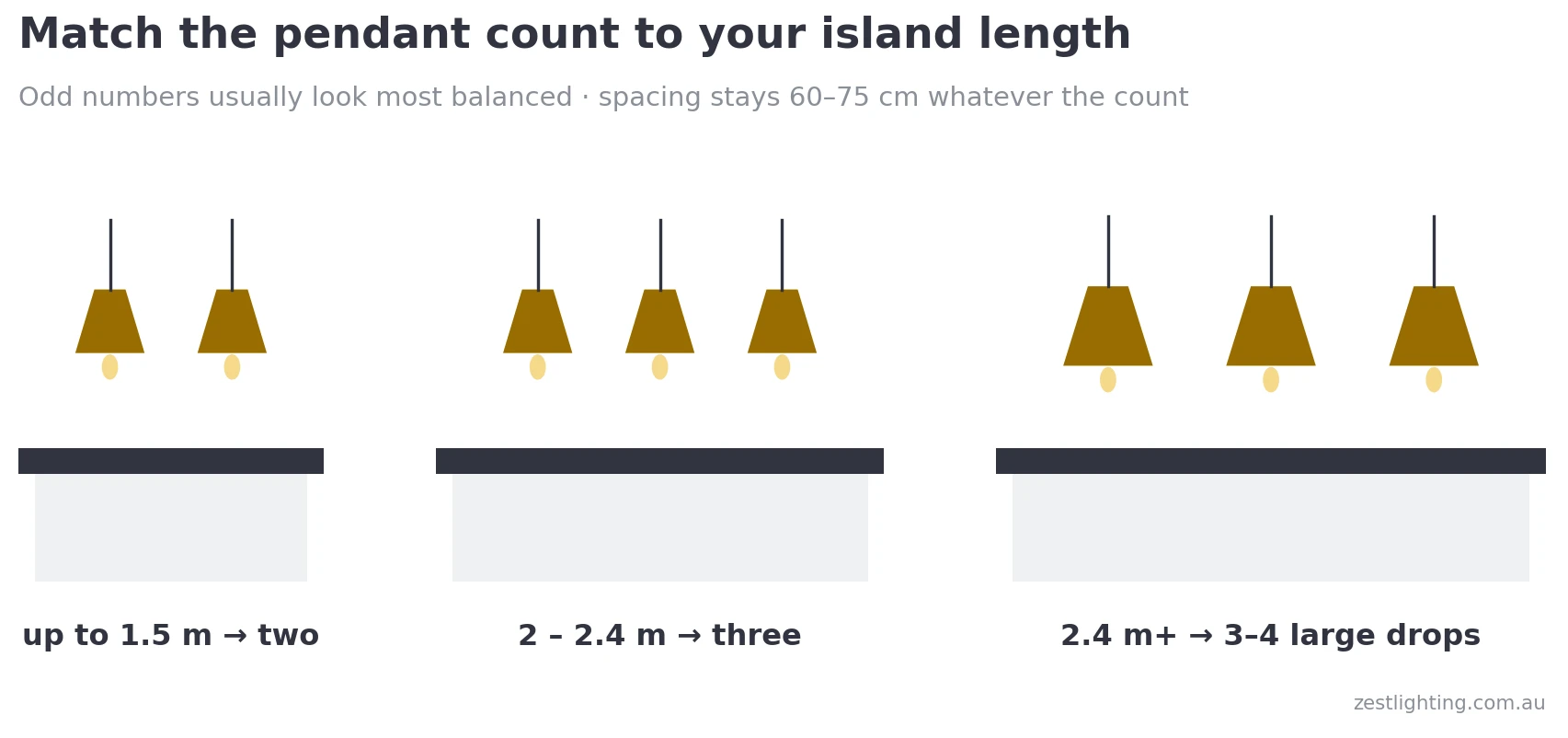
The Island Length Table: Quick Reference
The simplest starting point is your island’s length. Measure the benchtop edge-to-edge, then match it to the guide below. These figures assume pendants with a shade diameter of roughly 20–35 cm — the most common size for kitchen islands. Larger shades (40 cm+) may reduce the count by one.
| Island Length | Recommended Pendants | Notes |
|---|---|---|
| Up to 1.2 m | 1 (large) or 2 (small) | A single statement piece works well here |
| 1.5 m | 2 | Space pendants roughly 50 cm apart, centred on the island |
| 2.0 m | 3 | The sweet spot — three lights at ~60–70 cm centres |
| 2.4 m+ | 3–4 | Consider a linear bar for a cleaner look at this length |
If you’re still choosing between fixtures, browsing the full range of kitchen island pendant lights first will help you lock in a shade diameter before you commit to a pendant count.
The 60–75 cm Spacing Rule
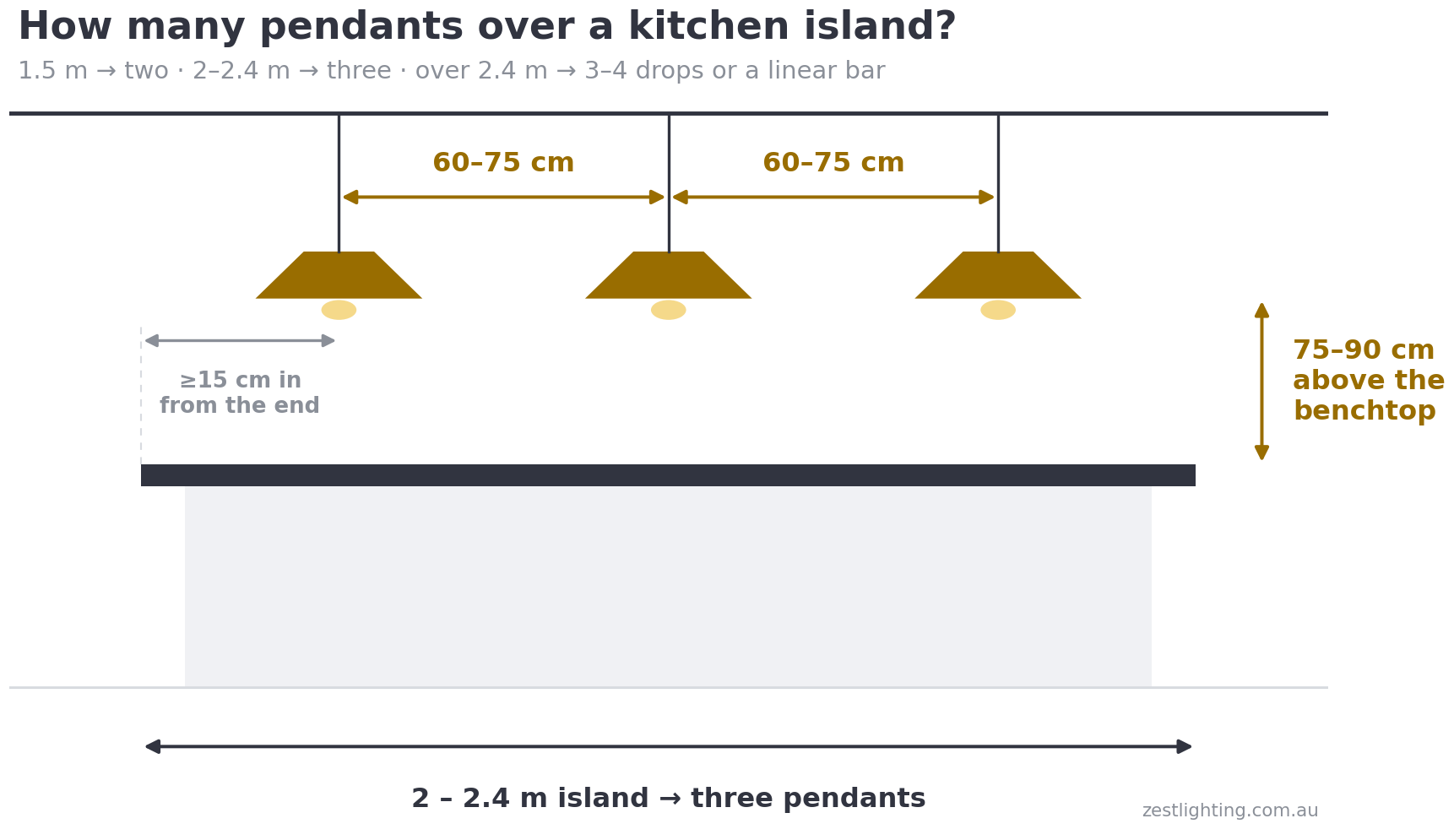
Once you know how many pendants you need, spacing them evenly is critical. The standard rule is 60 to 75 cm between pendant centres. Go tighter and the fittings feel cluttered; go wider and the island starts to look under-lit in the middle.
To calculate placement, subtract the shade diameter of your chosen pendant from 60–75 cm — that gives you the clear gap between shades. For example, three pendants with 30 cm shades spaced at 65 cm centres leaves 35 cm of breathing room between each fitting. That’s comfortable without being sparse.
Also leave at least 20–30 cm of clearance between the outer pendants and each end of the island. This stops the row from looking like it’s falling off the edge and maintains visual balance.
Hanging Height: 75–90 cm Above the Benchtop
Pendant height is just as important as pendant count. The standard Australian kitchen benchtop sits at 900 mm, and the bottom of your pendant shades should hang 75 to 90 cm above the benchtop surface — roughly 165–180 cm from floor level. This keeps the light focused on the work surface without putting a shade at eye level when you’re seated on a bar stool.
In a standard 2.4 m ceiling kitchen, that means your pendant cord or rod needs to drop around 60–75 cm from the ceiling rose — accounting for the height of the shade itself. Always check the total drop (cord/rod + shade height) on the product page before ordering, and confirm there’s enough adjustment for your specific ceiling height.
Low Ceiling Variations
If your kitchen has ceilings lower than 2.4 m, push toward the lower end of the hanging height range — or consider flush-mount options, slimline shades, or a linear bar pendant which often presents a lower overall profile. At 2.2 m, most pendants can still work comfortably; below 2.0 m, stick to very shallow shades or semi-flush ceiling fittings instead.
Odd Numbers vs. Even — Does It Matter?
You’ll often read that odd numbers of pendants look better, and there’s genuine design logic behind it: three or five pendants create a natural visual hierarchy with a centre focal point, which tends to feel more balanced to the eye. That said, two pendants over a 1.5 m island is a perfectly sound choice — it’s common, it works, and it’s proportionate.
The real rule is proportion over parity. A correctly spaced pair of pendants will always look better than three pendants crammed onto a short island just to hit an odd number. Let the island length and spacing maths drive the decision, then consider whether odd or even lands better for your specific kitchen layout.
The Linear Bar Alternative for Longer Islands
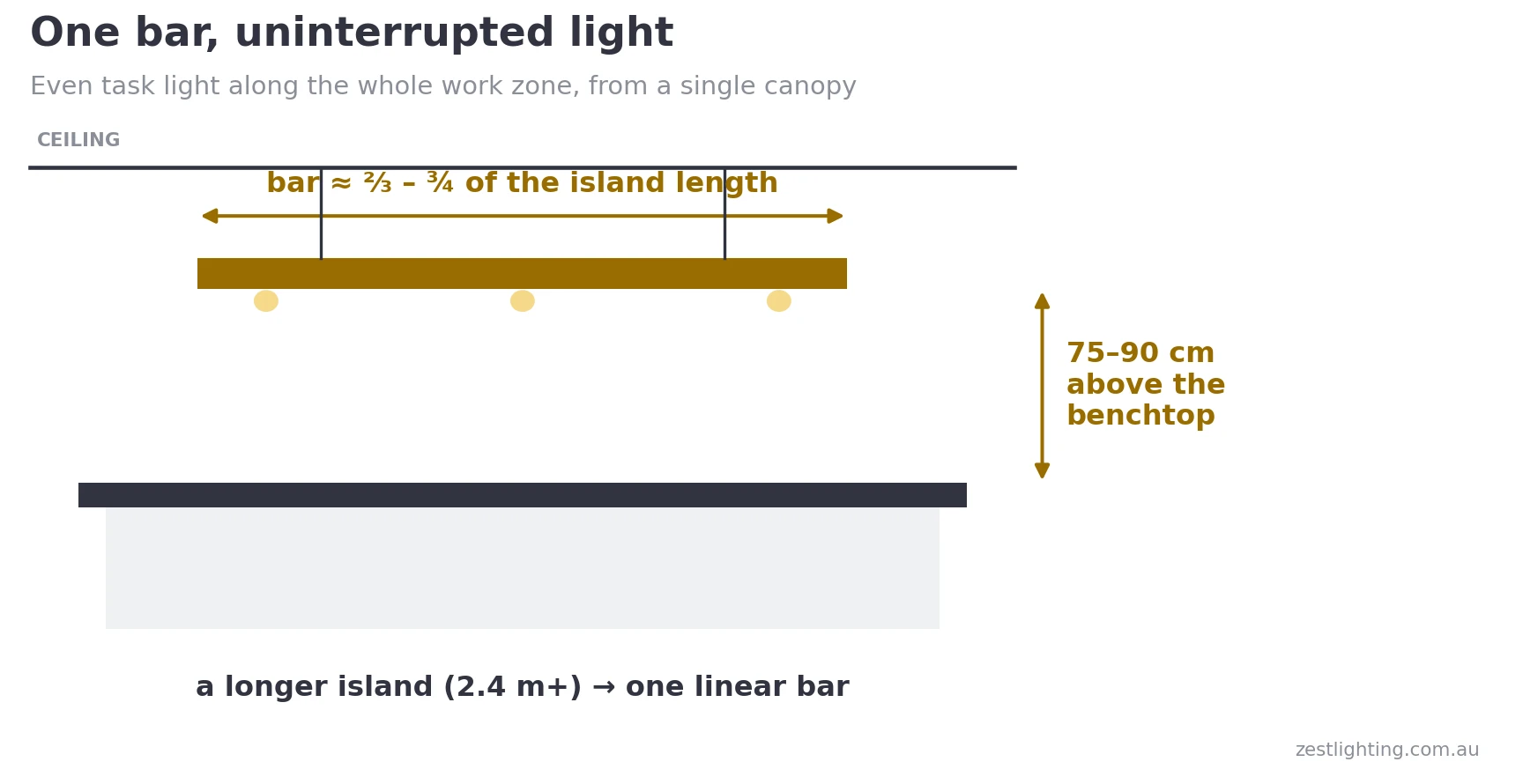
For islands of 2.4 m and beyond, or any kitchen where a clean, contemporary look is the priority, a single linear bar pendant light can replace multiple individual pendants entirely. A bar fitting spanning roughly two-thirds to three-quarters of the island’s length — around 1.4–1.8 m on a 2–2.4 m island — throws an even spread of light when hung at the same 75–90 cm above benchtop height.
The practical advantages: one ceiling canopy, one power connection (all Australian hardwiring must be done by a licensed electrician), and a unified visual line that suits Scandi, industrial, and minimalist kitchens particularly well. The trade-off is less flexibility — you can’t mix heights or stagger positions the way you can with separate pendants.
Putting It All Together Before You Buy
Run through this checklist before adding anything to cart:
- Measure your island length and cross-reference the table above for pendant count.
- Check the shade diameter on the product page and apply the 60–75 cm centre-to-centre spacing rule.
- Calculate the total drop (cord/rod + shade) against your ceiling height, targeting 75–90 cm above benchtop.
- Confirm dimmability if you want mood lighting — not all pendants include a compatible dimmer; check the spec sheet.
- Consider finish longevity — in coastal Australian kitchens, salt air can accelerate oxidisation on some metallic finishes; look for powder-coated or sealed options where relevant.
For broader kitchen planning beyond the island, the kitchen lighting category covers task, ambient, and cabinet lighting to complement your island pendants.
FAQs
How many pendant lights over a 2 m island?
Three pendants is the standard recommendation for a 2 m island. Space them at approximately 60–70 cm centres, leaving 20–30 cm clearance at each end, and hang the bottom of the shades 75–90 cm above the benchtop surface.
How far apart should pendant lights be over an island?
The widely used rule is 60 to 75 cm between pendant centres — measured from the middle of one shade to the middle of the next. The exact gap depends on your shade diameter; larger shades need slightly more breathing room between them to avoid a cluttered look.
How high should pendant lights hang over a kitchen island?
Aim for the bottom of the shade to sit 75 to 90 cm above the benchtop — which is typically around 165–180 cm above floor level in a standard Australian kitchen. Lower than 75 cm risks the shade intruding into sightlines; higher than 90 cm reduces focused task lighting on the bench surface.
Is one pendant light enough for a kitchen island?
One large pendant can work well on a compact island up to about 1.2 m long, especially if the shade diameter is 40 cm or more. For anything longer, a single pendant will leave the ends of the island under-lit — two or three fittings (or a linear bar) will give far better coverage.