

Best Desk Lamps for the Home Office (Australia)
14th Oct 2026
The best desk lamps for a home office deliver focused, adjustable light at the right colour temperature, without throwing glare onto your monitor. For most people, that means a lamp with at least 400 lumens of task output, a flexible or multi-joint arm, and a colour temperature around 4000K for screen-based work.
How Much Light You Actually Need at a Desk
The general rule for task lighting is 300 to 500 lumens directed at your work surface. That range covers reading, writing, and keyboard work. If you’re doing detailed work like drawing, fine crafts, or reviewing printed documents, push toward 700 to 800 lumens. Ambient light in the room matters too: a darker study needs a brighter lamp because the contrast between the lit surface and the surrounding space is what causes eye strain, not the lamp itself.
Most LED desk lamps list lumen output on the product page. If a lamp only quotes wattage, 8W in a quality LED fitting typically produces around 600 to 700 lumens. Halogen and incandescent equivalents run hot and are increasingly hard to find in quality fittings, so LED desk lamps are the practical starting point for any new purchase.
Colour Temperature for Screen Work
Colour temperature is measured in Kelvin. Warm white (2700K to 3000K) is relaxing and suits a reading nook or bedroom desk, but it can make white paper look slightly yellow and can feel a little dim for focused work. Cool white (5000K to 6500K) is bright and clinical, closer to daylight, which sounds appealing but often feels harsh after a few hours.
For most home office use, 4000K sits in the right spot. It reads as neutral white, makes screens easier to look at in a mixed-light environment, and doesn’t fatigue your eyes the way a very cool lamp does. Some lamps let you switch between colour temperatures, which is useful if you use the same desk for work during the day and reading at night. Check the product listing for colour temperature options, as this varies considerably across models.
Adjustable Arms and Positioning the Light to Avoid Glare
The position of the lamp head relative to your monitor is where most people get it wrong. Place the lamp to the side of your monitor, not behind it and not directly in front. For right-handed writers, the lamp should generally be to the left so your hand doesn’t cast a shadow across your work. Left-handers, reverse that.
Angle the head downward toward the desk, not toward you or the screen. If you can see the light source directly from your seated position, the lamp is too low or too far forward. A good adjustable arm lets you dial in that position precisely. Multi-joint arms with a spring-loaded mechanism offer the most flexibility; single-pivot lamps are simpler but limit how far you can extend the light across a wide desk.
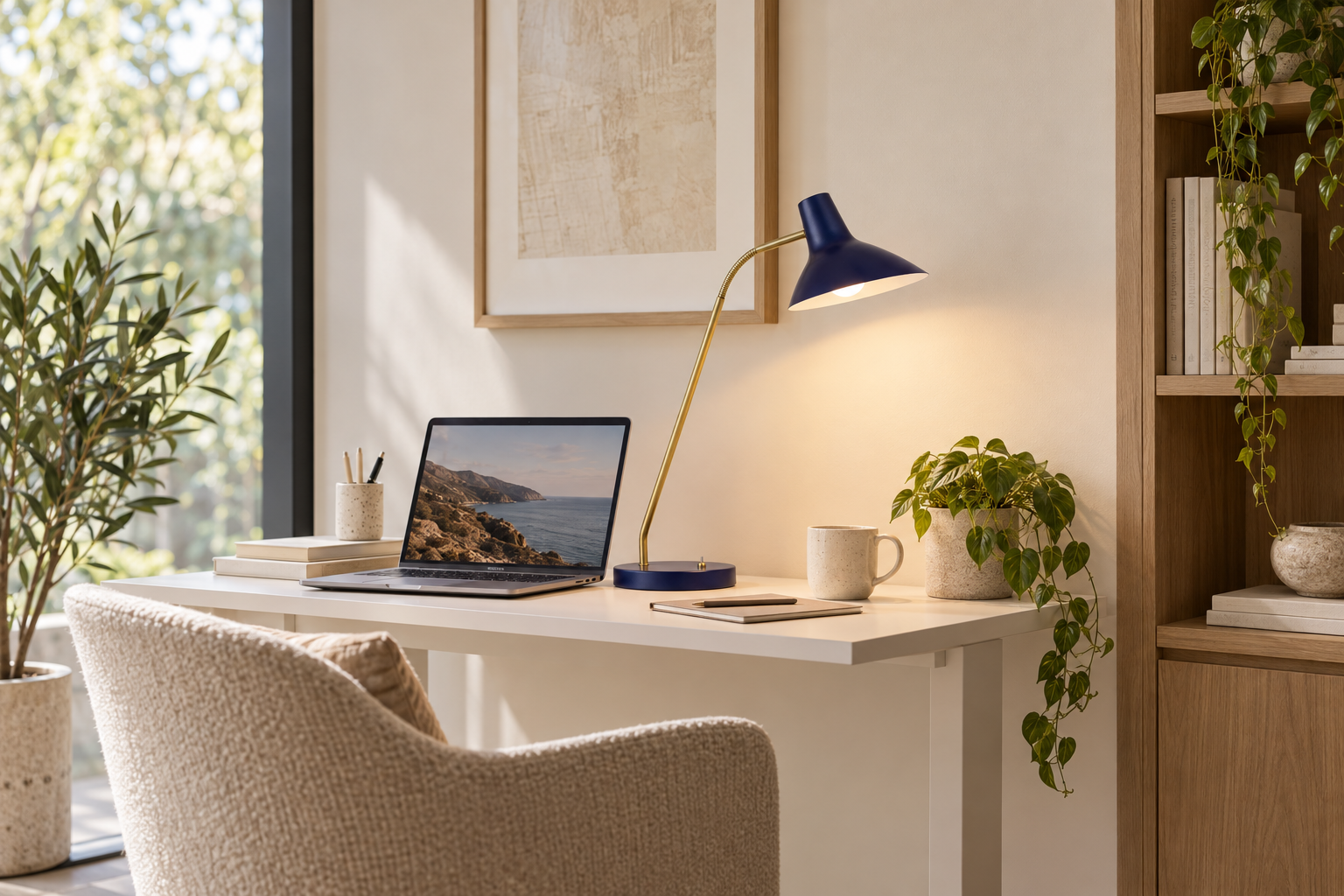
Browsing the full range of desk lamps by arm style is a good way to filter quickly. Swing-arm and articulated designs are worth prioritising if you shift between tasks throughout the day.
USB Ports and Wireless Charging
A built-in USB-A port for charging your phone while you work is one of those features that sounds small but makes a real difference on a tidy desk. Some models go further with wireless charging pads built into the base. We get asked about this most weeks, and the honest answer is that it’s worth having if your phone supports Qi wireless charging, but it doesn’t need to be a deciding factor if the light quality of that model isn’t quite right.
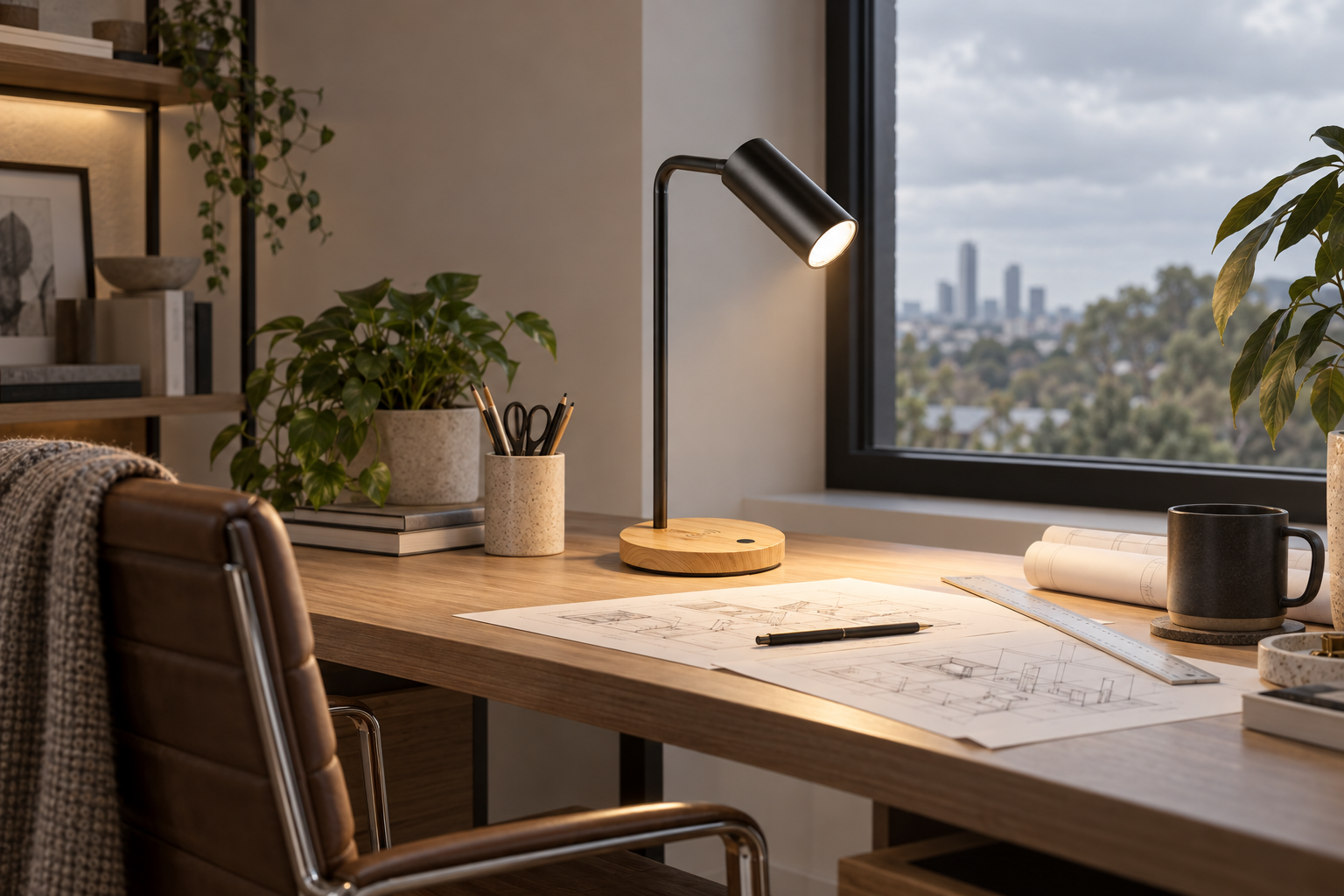
Check the product page for charging specs on any lamp you’re considering. USB-C and wireless charging availability varies by model, and wattage ratings for charging differ too, which affects how quickly your device tops up.
Bankers Lamps as the Style Pick
If the home office is in a living area or a room that doubles as a study, the lamp’s appearance matters as much as its output. The classic banker’s lamp design, with its green glass shade and warm brass base, reads as a deliberate design choice rather than office furniture. It’s one of the few desk lamp styles that looks as good in a lounge-room setting as it does at a writing desk.
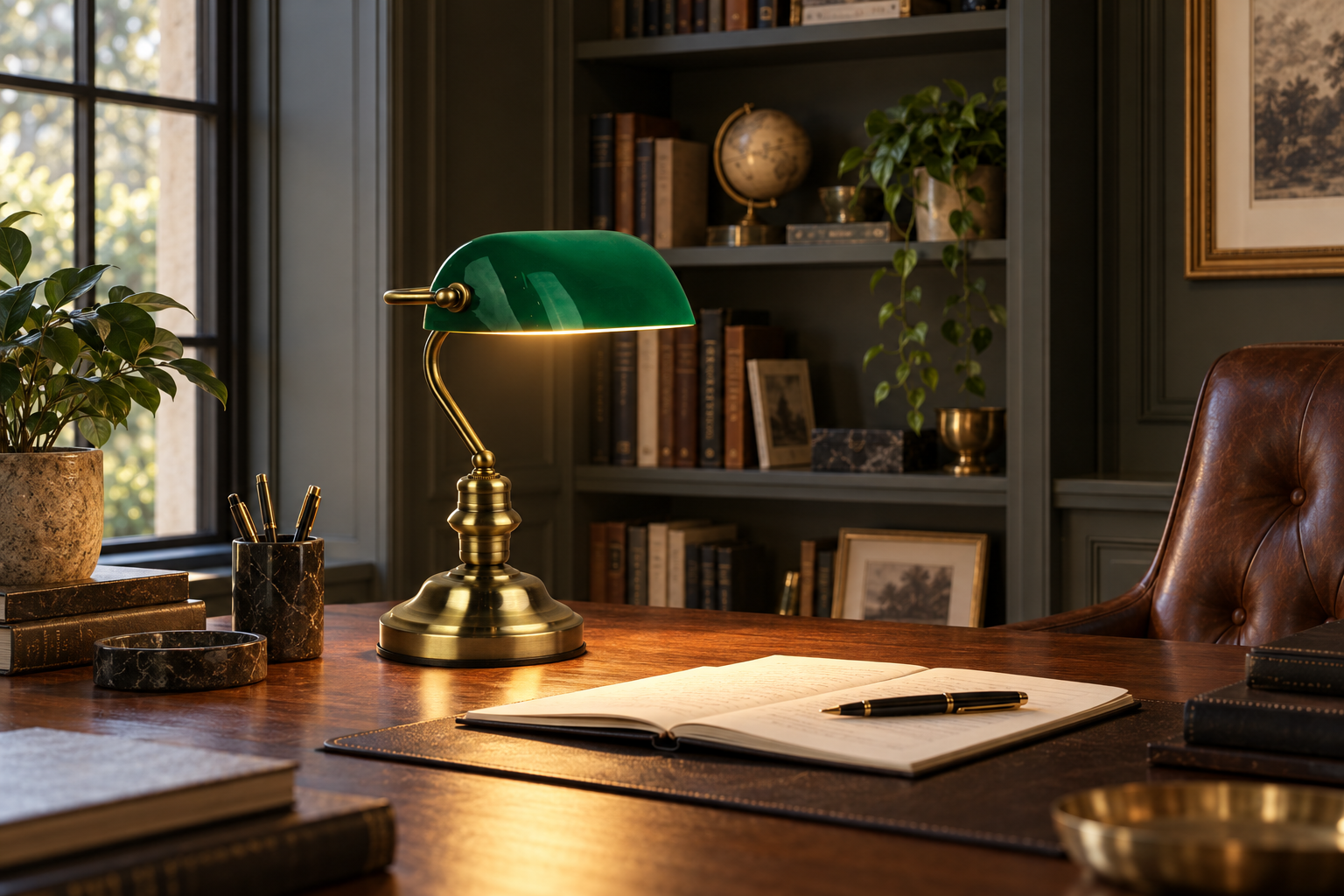
The downward-facing shade on a banker’s lamp is also well-suited to desk work because it naturally directs light onto the surface and away from your eyes. The trade-off is that they’re fixed in position, so they work best on a dedicated writing or reading desk rather than a workstation where you’re constantly repositioning. Have a look at the bankers lamps range if that style appeals.
FAQs
What colour temperature is best for a home office desk lamp?
4000K neutral white is the most practical choice for screen-based work and reading. It’s bright without the harshness of cool white (5000K and above), and it doesn’t create the warm yellow cast that can make detailed work harder at 2700K.
How many lumens does a desk lamp need?
300 to 500 lumens is enough for general desk work in a reasonably lit room. Bump that to 700 to 800 lumens for detailed or fine work, or if your study has little ambient light. Most quality LED desk lamps list lumen output on the product page.
Do I need a lamp with a USB charger or wireless charging?
It’s a genuinely useful feature if your desk is short on power points, but it shouldn’t override light quality as the main buying criterion. Wireless charging is only useful if your device supports Qi, and charging wattage varies between models, so check the spec before assuming it’ll fast-charge your phone.
Can I use a desk lamp as the only light in my home office?
Not ideally. A desk lamp used in a completely dark room creates a sharp contrast between the lit surface and the surrounding darkness, which causes more eye fatigue than working with ambient light. Use a ceiling or floor lamp alongside your desk lamp to bring the background brightness up.