

Bedroom Pendant Lighting Ideas: Bedside Drops and Beyond
16th Oct 2026
Pendant lights work brilliantly in bedrooms, whether you’re hanging a single statement shade over the centre of the room or dropping a pair of pendants either side of the bed in place of traditional bedside lamps. The trick is getting the drop height right and choosing a shade that throws light in the right direction for how you actually use it.
Why Pendants Instead of Bedside Lamps
Bedside table lamps are so standard that most people never question them. But a lamp takes up a meaningful chunk of nightstand real estate, and if your table is on the smaller side, you’re constantly shuffling it around your book, phone, glass of water, and everything else that accumulates there. Dropping a pendant from the ceiling frees the whole surface.
It also changes the quality of the light. A shade hanging at around shoulder height when you’re sitting up in bed puts the light source closer to the page or screen you’re reading from, with less spill across the room to disturb a sleeping partner. Wall lights do the same job, and bedside wall lights are worth considering if ceiling drops aren’t practical in your layout. But pendants have a visual weight and drama that a wall bracket rarely matches.
Getting the Drop Height Right
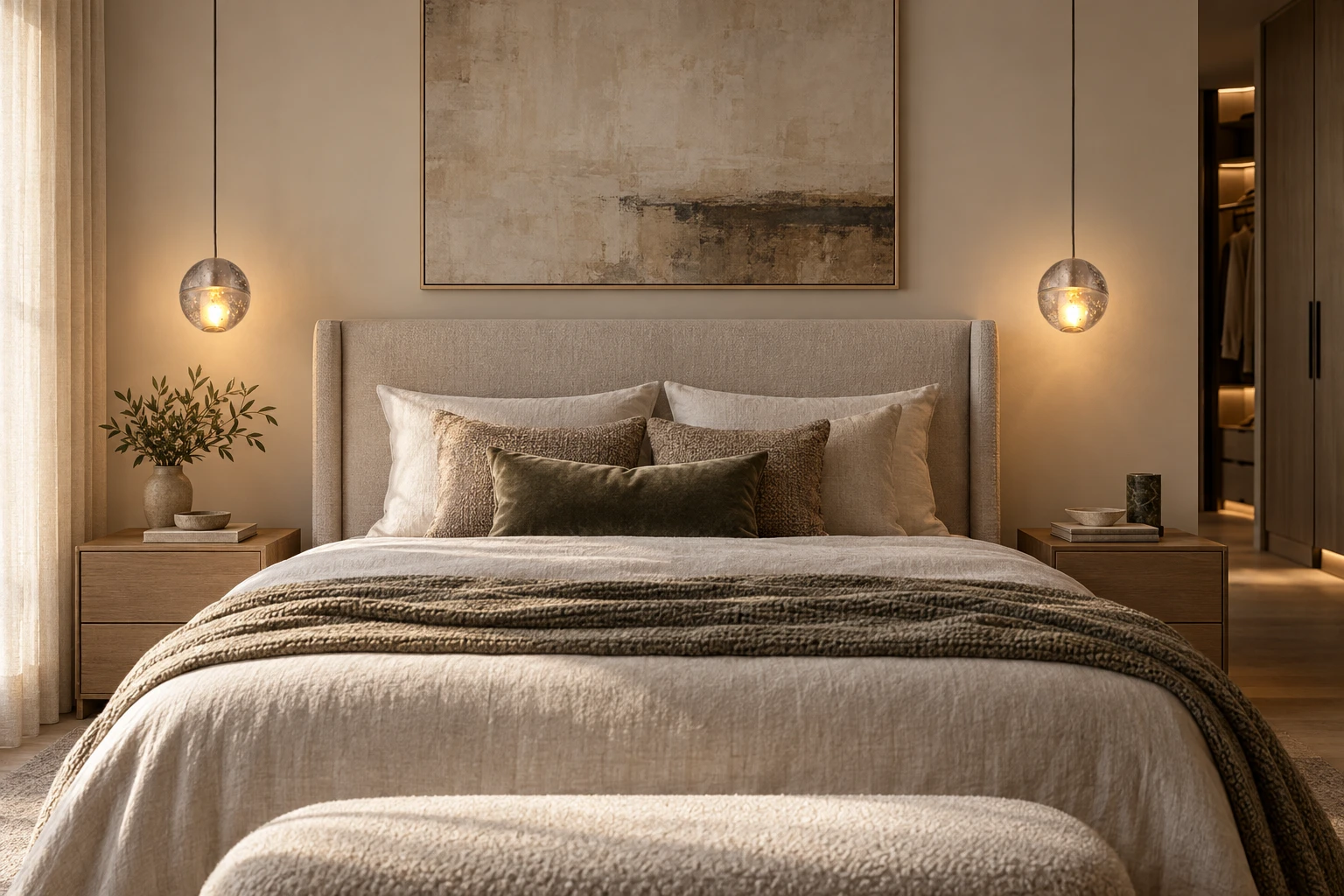
This is where most people go wrong. In a standard 2.4m bedroom, a bedside pendant should hang so the bottom of the shade sits roughly 45 to 60cm above the top of the mattress. That puts it at a comfortable reading height when you’re propped up on pillows, and keeps it out of eyeline when you’re lying flat.
For a central pendant over the bed, or a statement shade in the middle of the room, you want more clearance. Aim for the bottom of the fitting to sit at least 210cm off the floor so nobody clips it walking past. In rooms with higher ceilings, you can afford to drop further and let the shade become more of a feature.
If you’re working with a very low ceiling, a semi-flush fitting from the full bedroom lighting range might be a safer call than forcing a pendant into a space that doesn’t have the height for one.
Symmetry, Asymmetry, and a Single Statement
Matching pendants either side of the bed is the most popular approach, and for good reason. It looks considered, it gives each sleeper their own light, and it suits most bed sizes from queen upward. The pendants don’t have to be identical, but if you go mismatched, make the difference intentional rather than accidental. Two different shades in the same material or colour family can look deliberate; two completely unrelated fittings usually look like a mistake.
A single pendant hung slightly off-centre, or centred over a bed pushed against one wall, works well in smaller rooms or in spaces where you want the pendant to do double duty as ambient and task light. One larger shade can cover the whole bed for general illumination and still be put on a dimmer for evening use.
Don’t overlook the option of a pendant in a corner reading nook or over a dressing table. Bedrooms aren’t only about sleeping, and a well-placed pendant over a vanity or armchair can define that zone nicely.
Shade Styles That Work in Bedrooms
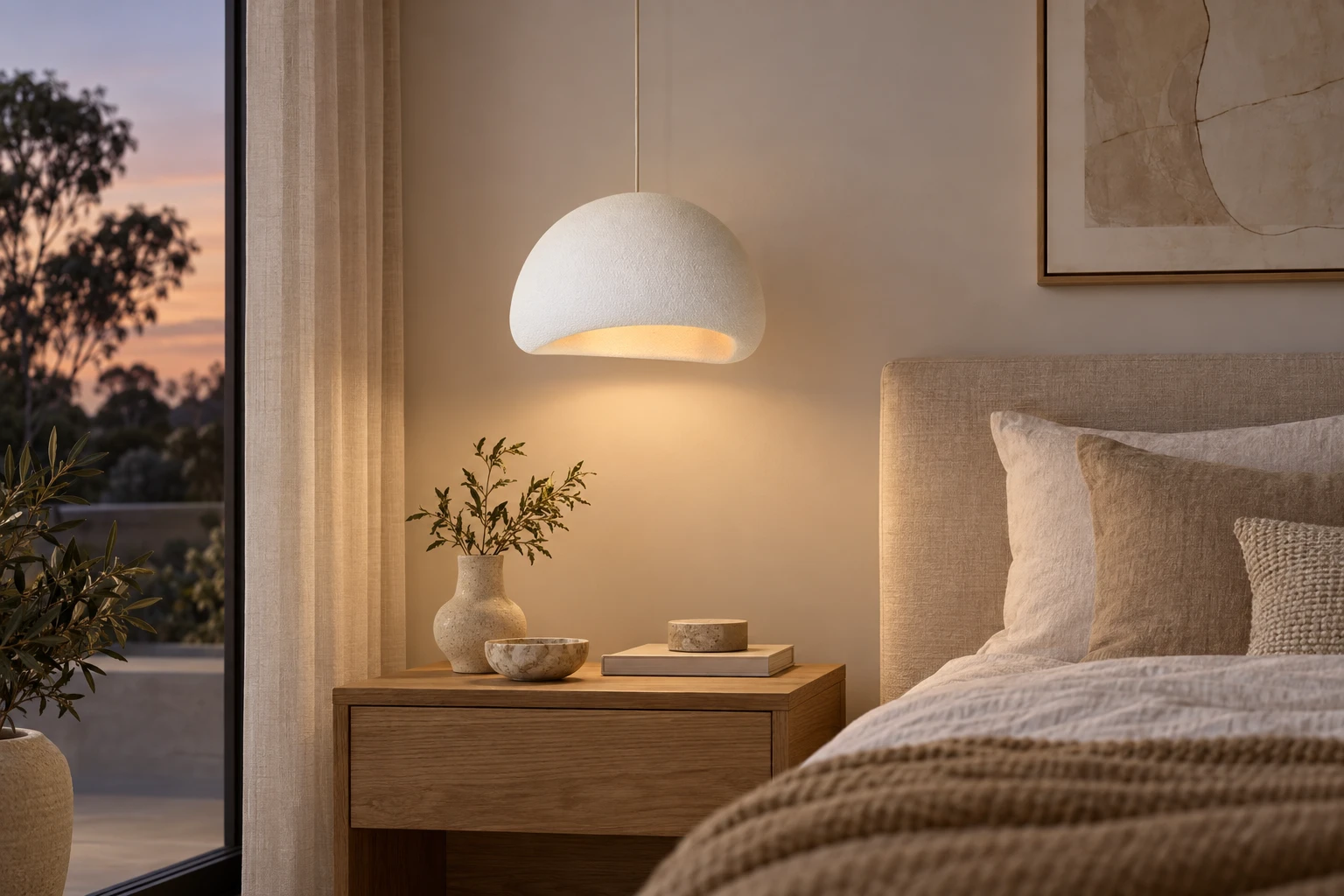
The shade shape affects where the light goes, which matters more in a bedroom than almost anywhere else in the house. A downward-facing open cone or dome directs light onto the nightstand and book in your hands, which is what you want for reading. A globe or spherical shade throws light in all directions and works better as ambient light than task light. A fully enclosed shade gives a soft, diffused glow that’s lovely for wind-down but won’t cut it as a reading light on its own.
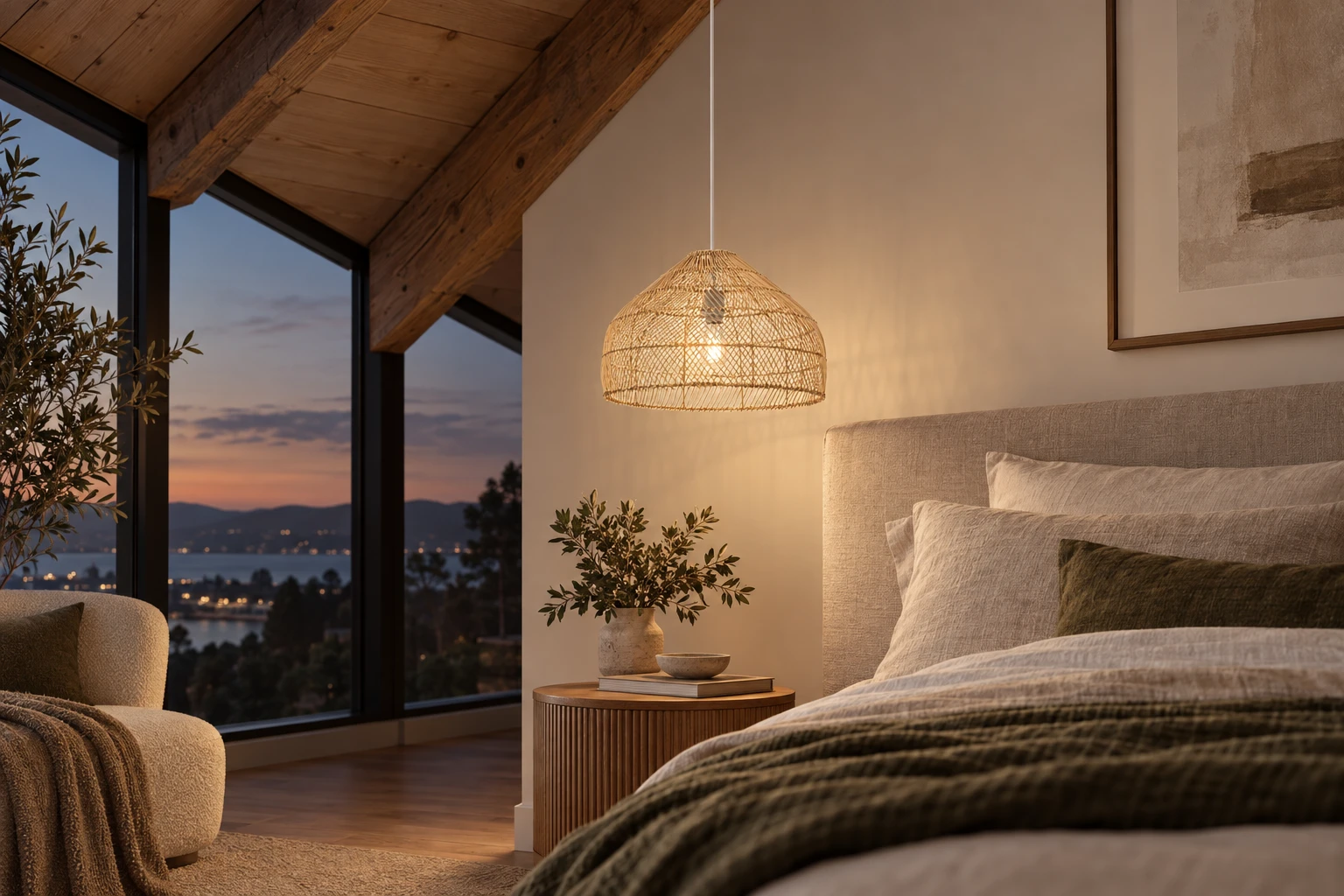
Natural materials like rattan, linen, and woven grass have become genuinely popular in bedrooms over the last few years, and they earn it. They soften the light naturally and tend to sit well against the textures you find in a bedroom: timber, cotton, aged brass hardware.
Dimming and Colour Temperature
A bedroom pendant that can’t be dimmed is a missed opportunity. The whole point of evening lighting in a bedroom is to help your brain wind down, and a fixture running at full brightness until you hit the switch does the opposite. Check that the pendant you choose is compatible with a leading-edge or trailing-edge dimmer before you buy, and confirm the globe is dimmable too. Many LED globes are not dimmable by default. Selected models in our bedroom pendant lights range include dimmable globes or specify compatible dimmer types on the product page.
Colour temperature matters just as much. Aim for 2700K to 3000K in a bedroom. That warm white range is close to candlelight and incandescent globes, and it reads as restful rather than clinical. Avoid anything above 3500K in a bedroom context.
One practical note: all pendant hardwiring in Australia must be carried out by a licensed electrician. If you’re repositioning a ceiling rose to centre a pendant over the bed or installing new pendant points, factor in the cost of an electrician visit. It’s a one-off job that makes a real difference to how the room looks.
FAQs
How high should a pendant light hang above a bedside table?
The bottom of the shade should sit roughly 45 to 60cm above the top of the mattress, which usually puts it at a comfortable height for reading when you’re sitting up. Adjust a few centimetres either way based on the shade size and how directional the light is.
Can I use a single pendant light in a bedroom instead of two?
Yes, and it can look great. A single pendant works well centred over the bed for ambient light, or positioned over a specific zone like a reading chair or vanity. If both people in the bed need independent reading light, two pendants or a combination of one pendant and a wall light is more practical.
Do bedroom pendant lights need to be dimmable?
They don’t have to be, but it’s strongly worth it. Evening light in a bedroom should be low and warm, and a non-dimmable pendant gives you an on/off choice with nothing in between. Check both the fitting and the globe for dimmer compatibility before purchasing.
What style of pendant light suits a coastal or rattan bedroom aesthetic?
Natural material shades, rattan domes, woven grass globes, and linen drum shades all suit a relaxed coastal or Japandi bedroom. Pair them with a brushed brass or matte black canopy for hardware that doesn’t fight the shade material. Salt air can affect metal fittings over time in coastal homes, so check the product specs if the room is in a high-humidity or ocean-facing position.